PFRS S1 and S2 Reporting Readiness: 5 Priorities and Key Actions
Insights from our Executive Briefing, regulators, and our experience delivering reporting and disclosure solutions to clients around the world

Insights from our Executive Briefing, regulators, and our experience delivering reporting and disclosure solutions to clients around the world


Sustainability reporting in the Philippines is entering a new era of corporate disclosure. The introduction of Philippine Financial Reporting Standards (PFRS) S1 and S2, aligned with the International Sustainability Standards Board (ISSB) global baseline, marks a significant step towards more consistent, comparable and investor-focused sustainability reporting.
The Securities and Exchange Commission (SEC) supports companies in this transition through a phased implementation roadmap. As early as 2027, the largest listed entities in the Philippines will be required to report climate-related disclosures, followed by broader sustainability-related disclosures the year after. The rigour of the PFRS framework means companies now need to build governance structures, data systems, and reporting capabilities to meet the requirements effectively.
Learn more about PFRS S1 and S2 here: Understanding Sustainability Reporting in the Philippines – PFRS S1 and S2
While momentum is building, sustainability maturity across the Philippines remains at an early stage. A July 2025 baseline study by the Employers Confederation of the Philippines (ECOP), supported by the International Labour Organization (ILO), found that stakeholders rated the country’s sustainability maturity at only 2-3 out of 5. The findings suggest that many organisations are still navigating the fundamentals of sustainability management and reporting, with surveyed companies identifying complex reporting requirements, ESG data challenges, capability gaps, competing priorities, and resistance to change among the key barriers to progress.
Building readiness for sustainability-related financial disclosures is a complex organisational challenge. Organisations are starting from different levels of maturity, but successful implementation of PFRS S1 and S2 requires more than the efforts of a sustainability team alone. Success depends on active leadership support and coordinated action across strategy, risk, finance, operations, and data functions to embed effective governance and reporting practices. While the final report is the visible outcome, the real work lies in embedding sustainability-related considerations throughout the organisation as a means of creating long-term business value.
These themes were evident during Anthesis Philippines’ executive briefing, Preparing for PFRS S1 and S2: Practical Steps for Implementation. Through participant surveys, live polls, audience questions and speaker insights, the session highlighted that many organisations are navigating a common set of implementation priorities and obstacles as they prepare for sustainability-related financial disclosures.
The key takeaway was that PFRS S1 and S2 readiness does not need to be achieved all at once. By focusing on clear priorities and taking a phased approach, organisations can build capability and momentum over time.
Prior to the webinar, participants were asked about their organisations’ readiness priorities, barriers, and implementation needs for PFRS S1 and S2. Consistent with the findings of the ECOP study, many identified data quality and availability, a stronger understanding of PFRS S1 and S2 requirements, and cross-functional alignment as key priority areas. Participants also indicated a need to build internal capabilities, establish clear implementation plans, and translate sustainability commitments into practical actions across the organisation.

The webinar polls further reinforced these findings. Most respondents indicated that their organisations were still building their readiness for PFRS S1 and S2. Responses also pointed to the need to further strengthen internal capabilities, particularly in the areas of climate risk assessment, sustainability data and reporting systems, staff capability, and cross-functional coordination.
Drawing on insights from the ECOP study, participant surveys, webinar polls, audience questions, and speaker experiences, Anthesis identified five recurring themes shaping organisations’ PFRS S1 and S2 readiness journeys. These themes reflect the common priorities and focus areas that organisations are navigating as they prepare for sustainability-related financial disclosures, as well as practical actions that can help move organisations from planning to implementation.
Data quality and availability emerged as a key focus area for many organisations. In many cases, the difficulty is not a lack of information, but rather how that information is managed. Relevant data exists across different functions, files, and systems, and varying definitions and calculation methodologies can affect consistency and comparability. Bringing these multiple data sources together in a way that is complete, reliable, and decision-useful remains a significant undertaking.
What experience shows: Ayala Corporation’s Sustainability Partnerships and Reporting Lead, Paolo Monteiro, offered a reassuring perspective: organisations may be surprised by how much information they already have. “Data does indeed improve over time.” In Ayala’s experience, the real challenge has been building alignment around what information is needed, why it matters, and who is accountable for collecting, validating and reviewing it.
Developing a mature reporting process is a journey that requires continuous refinement – a robust reporting practice is not built overnight.
Over 18 years, Ayala has evolved its reporting cycle into a disciplined process underpinned by common templates, rigorous reviews, group-level oversight, and independent assurance. Reflecting on this journey, Paolo added, “We are by no means perfect, but we try to make little steps every single day.”
~ A practical way forward: Start by identifying the most important information needed for reporting and assessing what is already available across the organisation. For each item, record its source, definition, calculation methodology, owner, reviewer and supporting records. A practice reporting cycle can reveal gaps early and allow data quality to improve over time.

Many companies understand the broad direction of PFRS S1 and S2 but remain uncertain about where to begin. This is understandable, given that organisations approach implementation from different starting points in terms of reporting maturity, data availability and readiness.
What experience shows: SEC Director Atty. Rachel Gumtang-Remalante described the Philippines’ earlier sustainability reporting requirements as the beginning of the journey, rather than the destination. The adoption of globally aligned standards builds on this foundation, enabling Filipino companies to meet evolving investor and market expectations.
“Good sustainability reporting should help explain how sustainability and climate-related matters affect the company and how the company responds to them.”
Gregor Theinschnack, a Principal Consultant at Anthesis and an IFRS Level 2 certified practitioner, emphasised that taking stock is the most effective place to start. He highlighted the need to conduct an early gap analysis and develop a roadmap to address identified gaps, calling this “one of the keys to success.” This helps organisations identify reporting priorities, determine what information is needed for reporting, focus efforts where they matter most, and build on existing sustainability reports, processes and systems rather than starting from scratch.
~ A practical way forward: Turn the standards into a practical roadmap for understanding, managing, and disclosing the ESG issues that matter most. Use the results of the gap assessment to identify what can be retained, what needs improvement and what needs to be developed. Organise the gaps by importance, effort, owner and timing.
Identifying climate-related risks is often the easier part. Flooding, typhoons, and extreme heat are familiar realities for many businesses in the Philippines. The 2025 World Risk Index highlights that the Philippines is one of the world’s most vulnerable countries to disaster risk. The more difficult task is translating these risks into business impacts, including their potential implications for operations, assets, costs, and future growth.
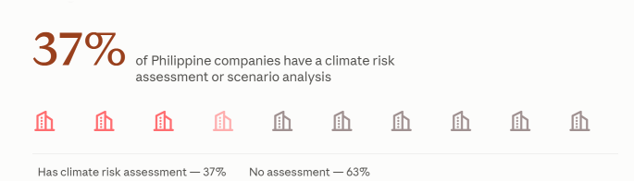
What experience shows: Michael Salvatico, APAC Climate & Nature Director at Anthesis, explained that climate risk assessments should support informed decision-making by helping organisations move from a broad understanding of climate-related risks to a more detailed evaluation of their likelihood, timing, and potential financial effects. Anthesis’ review of sustainability reporting practices among Philippine-listed companies with a market capitalisation of at least PHP 3 billion found varying levels of maturity in climate-related disclosures. Among the 148 companies reviewed, 55 (37%) disclosed some form of climate risk assessment or scenario analysis, while only 16 reported quantified potential financial effects. This highlights an opportunity for organisations to further strengthen the link between climate assessments and decision-making.
~ A practical way forward: Avoid trying to quantify every risk at once. Start with a small number of the most material risks and opportunities, using available operational and financial information. Be transparent about assumptions. The goal is not to predict the future with certainty, but to better understand potential impacts and inform decision-making, with the analysis becoming more sophisticated over time as data and experience improve.
Sustainability-related financial disclosures are rarely owned by a single team or individual. While sustainability teams often drive and coordinate reporting efforts, the information required typically resides across Finance, Risk, Strategy, Operations, HR, and business units, making clear roles, responsibilities, and coordination mechanisms essential. Without these, reporting can become fragmented and disconnected from the realities of practical decision-making.
What experience shows: Michael noted that PFRS S1 and S2 give finance, risk, and senior leaders a greater role because sustainability-related information needs to connect to financial and strategic decision-making. Paolo echoed this when he explained that Ayala’s governance structure, from its Board Sustainability Committee and Sustainability Council to its wider practitioner community, helps assign clear responsibilities and ensure that data is collected and submitted on time.
There is no one-size-fits-all model for sustainability reporting. What matters is clear accountability from leadership through to data owners.
Insights from our pre-session survey, which captured perspectives from Investor Relations, Risk, Sustainability, Finance and Communications, reinforced that success depends less on where reporting sits and more on how effectively functions work together to deliver it.
~ A practical way forward: Treat reporting as a business-wide project, with the Board and Senior Leadership setting the tone and reinforcing its importance across organisation. Assign a reporting lead and establish clear ownership for each disclosure, dataset, calculation, review, and approval. Equally important is equipping those involved with the context, training, and skills needed to fulfill their responsibilities. Where possible, leverage existing meetings, governance forums, and team huddles to support data collection and review, rather than creating entirely new processes.

Learn more about effective collaboration and best practice from what Group 1 reporters in Australia have experienced under the ISSB-aligned ASRS disclosures ASRS Executive Workshops | Key Insights | Australia
Building on the need to equip teams with the necessary skills, limited capacity, technical knowledge, time, and resources emerged as common concerns. Closing capability and resource gaps does not necessarily require large specialist teams. Targeted training can help data owners become familiar with the disclosure requirements and equip them to fulfil their roles effectively in supporting sustainability-related financial disclosures.
Experience shows building capability is often less about starting from scratch and more about strengthening existing knowledge and processes.
As Michael explained, “The bigger challenge is having people across the organisation who understand what information is required, why it matters, and how it connects to financial decision-making.” Gregor also noted that many Philippine companies are not starting from zero, with existing experience in sustainability and integrated reporting providing a valuable foundation to build on. Ayala’s experience further demonstrates that reporting maturity is built over time through regular training, repeated reporting cycles, and continuous improvement rather than within a single reporting period.
~ A practical way forward: Identify the skills needed for each role and provide focused training supported by practical templates and exercises. Use external specialists strategically to supplement internal capability, provide an independent perspective, and transfer knowledge to the organisation over time.
The discussions throughout the session made one thing clear: preparing for PFRS S1 and S2 is not a simple task. It requires time, effort, investment, and coordination across the business.
Yet the experiences shared by speakers and participants also reinforced that it is achievable. The foundations are already in place through previous reporting regimes, and this next stage of reporting maturity can be built progressively through clear ownership, practical processes, and continuous learning.
The opportunity extends beyond compliance.
While meeting regulatory requirements is necessary, the real value lies in the insights gained along the way. A clearer picture of sustainability-related risks and opportunities supports better decision-making, strengthens resilience, improves stakeholder communication, and helps identify new sources of long-term value.
Companies do not need to navigate this journey alone. Stakeholder insights, peer experiences, industry best practice, and external advisers can all help accelerate progress. The key is to take a practical and structured approach, building on existing strengths rather than striving for perfection from day one.
With that in mind, the following readiness checklist provides a starting point to help organisations assess their current state of readiness and identify priorities for implementation.
PFRS S1 and S2 readiness is built progressively rather than all at once. The following practical steps can help organisations strengthen their readiness and build momentum towards implementation:
As globally recognized sustainability and climate experts with strong regional expertise in APAC, we leverage years of experience in regulatory frameworks like ISSB, ESRS, and CSRD to help organizations manage climate risks and capitalize on emerging opportunities. Our mission is to transform compliance into a driver for sustainable performance, operational efficiency, and long-term stakeholder value.
Navigating these complex requirements for the first time can be daunting; however, our team provides the technical depth and implementation experience necessary to move beyond simple compliance. Reach out to our experts via the form below.
Anthesis Consulting Group Ltd. licenses and applies the IFRS® Sustainability Disclosure Standards and the SASB® Standards in our work. This means our approach is grounded in a globally recognised standard, giving clients confidence that the guidance we provide reflects the same rigour, integrity, and consistency investors expect from these frameworks.
We are the world’s leading purpose driven, digitally enabled, science-based activator. And always welcome inquiries and partnerships to drive positive change together.