Our net zero strategy for businesses supports organisations on their journey to reduce carbon and greenhouse gas emissions in buildings, operations and supply chains. Read our 6-step approach to building an effective Net Zero strategy.
According to the Science Based Target initiative (SBTi), “Net Zero emissions are achieved when anthropogenic [human-caused]emissions of greenhouse gases to the atmosphere are balanced by anthropogenic [human-led] removals over a specified period.”
In practice, achieving net zero means organisations must prioritise deep, absolute reductions in greenhouse gas emissions across their value chain, with only a limited role for carbon removals to address residual emissions that cannot yet be eliminated. This ensures real climate impact rather than a reliance on compensation alone. Net zero aligns with climate science and requires structural changes to business models, operations and supply chains.
This is distinct from carbon neutrality, which is often achieved through the purchase of carbon offsets without necessarily reducing underlying emissions.
To align with the 1.5°C climate ambition and limit the impact of climate change, the world needs to reduce net annual greenhouse gas emissions by at least 40 gigatonnes by 2050, making rapid and sustained emissions reductions essential.
Why is achieving Net Zero essential?
Achieving net zero is essential to limit the most severe impacts of climate change and to maintain economic, environmental and social stability. In response to the Paris Agreement’s goal of limiting global warming to 1.5°C, the UN’s Intergovernmental Panel on Climate Change (IPCC) has made clear that global greenhouse gas emissions must fall by around 45% from 2010 levels by 2030 to avoid the worst climate outcomes.
Exceeding this threshold significantly increases the risk of irreversible climate impacts, including more frequent and extreme heatwaves, prolonged droughts, intensified flooding and bushfires, food and water insecurity, ecosystem collapse, and widespread disruption to infrastructure and supply chains. These risks translate directly into physical, financial and operational impacts for organisations across sectors.
Delivering net zero goes beyond incremental emissions reductions. It requires a whole-economy transition that addresses emissions at their source, rather than relying on offsets alone, and supports long-term climate stability.
For businesses in Australia, achieving net zero is also a strategic and commercial imperative. Investors are increasingly assessing climate risk, resilience and transition credibility, while regulators are strengthening climate-related disclosure and governance requirements. The Australian Sustainability Reporting Standards (ASRS), introduced in 2025, mandate that under AASB S2, large companies must now declare their climate risks and opportunities in a Sustainability Report that is filed along with their financial reports.
Customers, employees and partners likewise expect organisations to demonstrate credible progress. Delivering net zero helps organisations build resilience, manage transition risk, maintain access to capital, and remain competitive in a rapidly evolving regulatory and market landscape.
What are the benefits of reaching Net Zero?
A comprehensive and successful net zero strategy is essential for building a resilient, thriving business. With a robust plan to reach net zero, your organisation can unlock a multitude of benefits including:
Enhanced brand image: Position your organisation as a leader in sustainability.
Innovation and investment: Drive innovation and attract investment in low-carbon solutions, creating new markets and business opportunities.
Energy security: Reduce reliance on fossil fuels, enhancing energy security and shielding economies from price volatility.
Cost savings: Achieve long-term cost reductions through energy efficiency and renewable energy adoption.
Risk mitigation: Reduce exposure to climate-related financial risks.
How to build a Net Zero strategy
Cities and corporations around the globe are setting targets to radically reduce their greenhouse gas emissions in order to control climate change. These targets and commitments often align with a desire to achieve net zero emissions by a certain date in the future. Simply put, this means balancing the associated emissions produced by an organisation’s operations and supply chain, and emissions taken out of the atmosphere.
Achieving net zero requires coordinated action touching on many aspects of the organisation. What may seem daunting can be broken down into strategic and manageable pathways for transformation that start with analytics, move on to developing solutions, and end in implementing change.
To support organisations at every stage of their journey, we have developed a practical guide to delivering net zero. The guide covers emissions analysis, science-based target setting, transition planning and governance considerations, helping organisations build a robust and actionable pathway to delivering net zero.
To achieve net zero emissions by 2050, we need to work together to deliver immediate change. To support organisations with the transition, our experts have created the following 6-step process for how you can create a net zero strategy.
Our Net Zero framework focuses on six key areas for organisations to consider in building a net zero strategy in transition to net zero:
Assess your risk & impact: Assess your climate risks, opportunities and climate impact
Set a target: Set a net zero target, aligned with science
Plan for the transition: Plan for the transition via a strategic roadmap, addressing risk and reduction
Implement reduction measures: Implement reduction and adaptation measures throughout your value chain
Invest in climate finance: Invest in climate finance to address residual emissions
Communicate performance: Communicate performance and enhance brand reputation
1. Assess your climate risks, opportunities and climate impact
Understand your current and future footprint
At the heart of the decarbonisation effort is the need to efficiently measure, track and understand the GHG emissions your organisation emits through a carbon inventory. In many cases, this is a requirement under national regulation and international frameworks such as the International Sustainability Standards Board (ISSB) standards IFRS S2 and the Australian AASB S2 standard.
By quantifying your emissions and identifying where your emissions come from, you can begin to determine opportunities for reduction. Pulling together the data and processing it into robust and reliable metrics can be difficult and time-consuming. Embedding a digital technology solution like RouteZero to calculate and visualise emissions can drastically improve how you manage your data and track ongoing progress.
Assess your climate risk and opportunities
All companies face risks and opportunities from climate change, both physical risks and those linked to the changes that societies and economies will undergo as we adapt to the realities of a warmer, net zero world. Leaders must understand the financial impact of these risks and implement strategies to mitigate and respond to them. Globally this is occuring as mentioned before under several mandatory standars – IFRS, ASRS and also CSRD and ESRS.
Companies must assess the risks and opportunities that climate change poses to each area of the organisation. Then they shoud evaluate the impact on financial results under different climate scenarios to provide clear, quantitative insights into areas of concern.
Once you have undertaken a GHG inventory, you can use this data to identify hotspots, drivers of emissions and reduction opportunities to understand how to reach net zero. Opportunities should be developed into clear targets, informed by the latest science, that can be communicated to stakeholders.
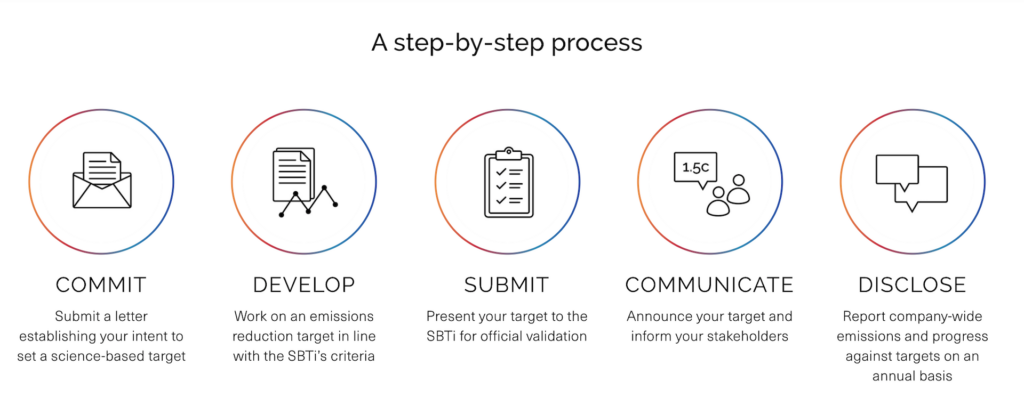
5 steps to setting a science based target
We support organisations to develop emissions-reduction targets consistent with the world’s carbon mitigation requirements to keep the globe below 2°C warming and align with Paris Agreement emission reduction forecasts.
Best practices for achieving Net Zero
3. Plan for the transition via a strategic roadmap, addressing risk and reduction
A climate transition plan is a comprehensive document that outlines a company’s response to the challenge of reaching global net zero. It should show the steps a company will take to adapt and, if necessary, transform its business to thrive in the low-carbon economy. A transition plan is an output of a process of transition planning inside the company and must contain all relevant details to prove its effectiveness in execution.
4. Implement reduction and adaptation measures throughout your value chain
All organisations are part of a connected network that shares the risks and opportunities associated with moving towards a net zero world. Implementing net zero strategies for your business will deliver sustainable performance that reaches many parts of your network, both internally across business functions, as well as externally with supply chain and customers.
5. Invest in climate finance to address residual emissions
As your reduction plans are underway, investing in climate finance, known as offsetting, can help you tackle unavoidable residual emissions by removing carbon from the atmosphere in a way that benefits societies and people.
Through a range of technology-based and nature-based programmes, Anthesis supports companies to invest in verified, guaranteed carbon credits that fund essential climate action.
6. Communicate performance and enhance brand reputation
Brands that commit to sustainability and purpose can inspire and motivate their teams, earn customer preference, drive investor confidence, and secure stakeholder credibility.
We support companies throughout their journey to communicate with stakeholders on net zero ambitions and progress clearly, accurately, and authentically.
Green Claims
In the context of net zero, green claims often relate to statements about emissions reductions, net zero targets, transition plans, or the use of offsets or removals.
These claims can be made about products, services, or the company as a whole, and may address any stage of the value chain. Net zero–related green claims typically focus on carbon emissions, but may also reference wider environmental and social impacts such as energy use, water, land use and supply chain practices.
Governments and businesses around the world have all differently set target dates for their own Net Zero impact. However, Net Zero by 2050 is often used as a reference point as it aligns with the Paris Climate Agreement’s statement that we must meet this target by mid-century if we are to avoid the most catastrophic impacts of climate change.
Climate science warnings state that if global temperatures continue to rise about 1.5C, lives and livelihoods across the globe will be impacted. The repercussions of a hotter world are hard to predict accurately, but expectations include mass climate migrations, food shortages, increased unpredictable weather events, as well as sea-level rises that could submerge whole countries.
Quite simply, no. Net Zero considers a range of greenhouse gas emissions, not just carbon. This includes Methane, Nitrous Oxide and Fluorinated Gasses, which also have an impact on the greenhouse effect.
A Net Zero target helps you know where to get to, and a carbon price helps you know how to get there. In particular, a carbon price can help you influence decision makers. You can apply internal carbon pricing to your investment process, for example, understanding your costs, and accounting for them, can also help you to achieve your overall Net Zero emission targets.
Who is involved in setting science-based targets?
SBTs are both a challenge and opportunity as they bring together disparate stakeholders, including:
Energy and Carbon stakeholders from facilities and finance
Sustainability teams
Product managers
In the supply chain: buyers, merchants and procurement organisations
Who is involved in setting science-based targets?
SBTs are both a challenge and opportunity as they bring together disparate stakeholders, including:
Energy and Carbon stakeholders from facilities and finance
Sustainability teams
Product managers
In the supply chain: buyers, merchants and procurement organisations
Who is involved in setting science-based targets?
SBTs are both a challenge and opportunity as they bring together disparate stakeholders, including:
Energy and Carbon stakeholders from facilities and finance
Sustainability teams
Product managers
In the supply chain: buyers, merchants and procurement organisations
What’s the difference between Science-Based and Net Zero Targets?
Science-based targets (SBTs) are near-term goals set by businesses that align with the scale of reductions required to keep global temperature increases well below 2°C compared to pre-industrial temperatures. Net Zero is a longer-term target to completely negate emissions produced, which also allows for absorbing remaining emissions through climate removals.
Achieving net zero requires coordinated action touching on many aspects of the organisation. What may seem daunting can be broken down into strategic and manageable pathways for transformation that start with analytics, move on to developing solutions, and end in implementing change.
Anthesis supports business leaders in navigating the complexity of achieving net zero, applying the comprehensive expertise of our net zero consultants and holistic solution to accelerate decarbonisation and climate resiliency and unlock commercial opportunity.
Get in touch
We’d love to hear from you
We are the world’s leading purpose-driven, digitally enabled, science-based activator. And always welcome inquiries and partnerships to drive positive change together.