Carbon Guide
March 2025
JULY 2026
Welcome to the July edition of our Carbon Guide.
At Anthesis, we’re seeing continued change across the Voluntary Carbon Market, alongside growing interest in high-integrity climate solutions. As a trusted partner across the global carbon market, Anthesis develops, owns and supports a diverse portfolio of projects worldwide – helping organisations navigate complexity and turn climate commitments into measurable, credible impact.
This month, we focus on the Science Based Targets initiative’s (SBTi) recent update and what it means for the Voluntary Carbon Market, plus we spotlight some of our latest projects.
In the News: Key Recent Developments
SBTi updates standard, introduces CO2 credit recognition scheme
After more than two years in development, the Science Based Targets initiative – the main arbiter of corporate climate targets – has unveiled its Corporate Net-Zero Standard Version 2.0 (CNZS2). The update introduces a new “Ongoing Emissions Responsibility” (OER) framework, designed to complement the organisation’s existing target-setting approach.
The 105-page rulebook sets out a voluntary recognition programme for high-integrity carbon credits and other climate contributions, positioning them as a complement to – rather than a substitute for – companies’ own emissions reductions.
Anthropic joins buyers’ coalition to commit to Carbon Dioxide Removals
US-based AI company Anthropic has joined an existing buyers’ coalition – including Stripe, Google, Shopify, Salesforce, and H&M Group – committing to purchase Carbon Dioxide Removals (CDRs). While using CDRs to offset AI-related investments isn’t new, Anthropic’s entry into the Voluntary Carbon Market marks a welcome step in the right direction.
SBTi expects ‘significant demand’ for carbon credits after update
The Science Based Targets initiative (SBTi) expects a sharp increase in demand for carbon credits from corporates with net-zero goals, following the launch of its updated standard this month, its CEO said. However, further details on which carbon credits can be used under the framework – and how – have yet to be published, meaning the anticipated boom in demand remains on hold for now.
UK telecoms outfit to use offsets, CDR for residual emissions
A UK telecoms company has set out plans to address its residual emissions using high-quality, durable offsets and carbon removals, in line with the SBTi’s Corporate Net-Zero Standard criteria. The plan prioritises projects that deliver co-benefits, including “biodiversity restoration, ecosystem protection and support for local communities”, and will adhere to the Integrity Council for the Voluntary Carbon Market’s Core Carbon Principles quality labels.
SBTi Corporate Net-Zero Standard v2.0: A Carbon Credit Strategy
The SBTi Corporate Net-Zero Standard Version 2.0, expected in Q4 2026, represents the most significant shift in the Voluntary Carbon Market since the original standard was introduced. While carbon credits still cannot replace direct emissions reductions, SBTi now formally recognises the use of high-integrity carbon credits as a supplementary form of climate action, through its new Ongoing Emissions Responsibility (OER) framework. Set to launch in 2027, the framework provides an important demand signal for the market, while maintaining the core principle that companies must first decarbonise their own operations.
Under the programme, “high-integrity emission reduction projects, avoidance projects, carbon removal projects and other eligible climate contributions” remain eligible until 2035. After that point, companies will be required to address a growing share of their ongoing emissions through carbon removals rather than reduction or avoidance credits. The proportion of long-lived to short-lived removals starts at 10% and increases gradually, reaching 100% by the company’s net-zero year.
| Period | Eligible under OER | Purpose |
|---|---|---|
| 2027–2035 (voluntary) | Reduction credits, avoidance credits, nature-based removals, engineered removals, and other eligible climate contributions | Recognition for companies delivering climate contributions |
| 2035–2050, or sooner net-zero year (mandatory for Category A companies) | Carbon removals only. At least 10% must be long-lived removals in 2035, increasing gradually to 100% by the net-zero year | Address a growing share of ongoing emissions |
As set out in the updated standard, companies must select a recognition level and, over the near-term target timeframe, deliver climate contributions at a scale determined by the required coverage of their ongoing Scope 1, 2 and 3 emissions under that level.
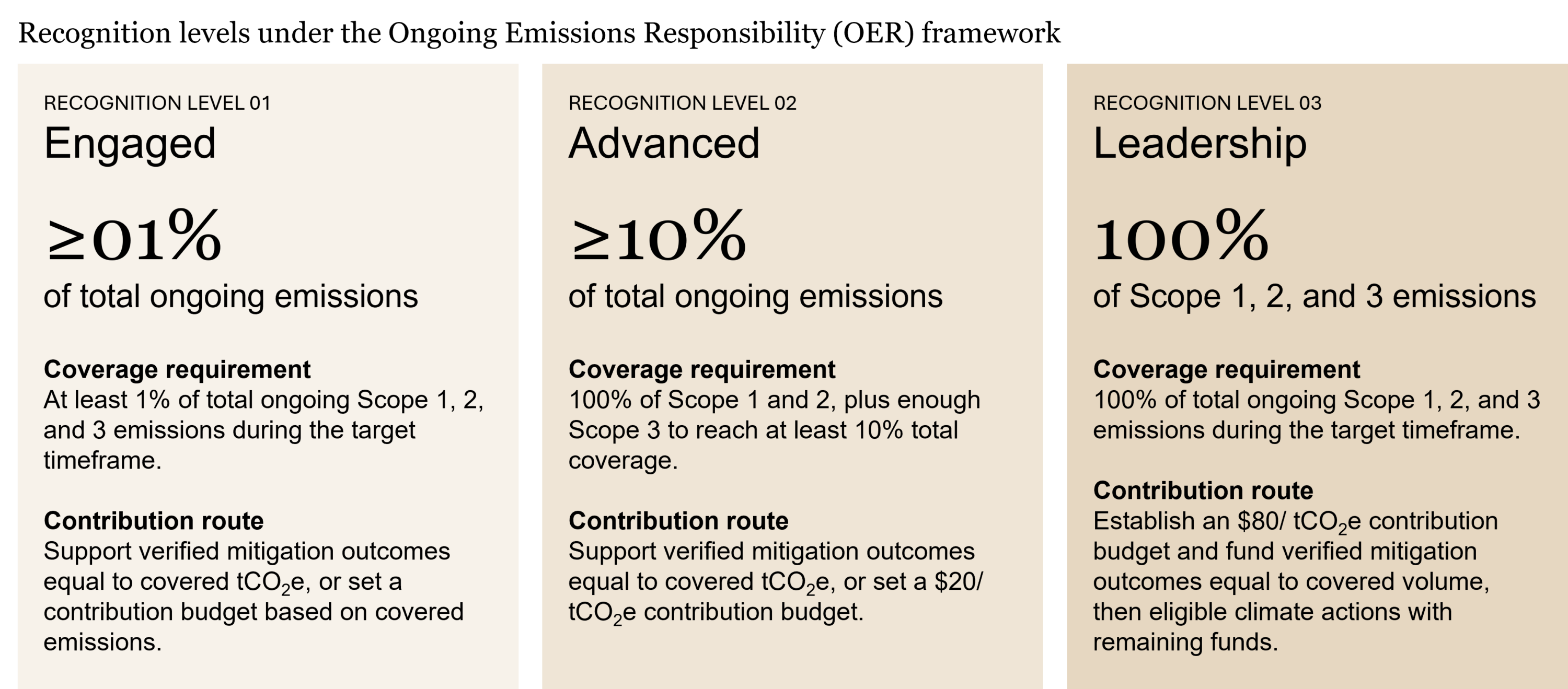
The revised standard also changes how organisations should communicate about carbon credits. Companies should continue to present emissions reductions within their own operations and value chains as the primary route to achieving their science-based targets. Carbon credits should be communicated separately, as supplementary climate action or beyond-value-chain mitigation, rather than as instruments used to achieve SBTi compliance. Claims suggesting that carbon credits have enabled a company to meet its science-based target, or to offset its Scope 1, 2 or 3 emissions, are no longer consistent with the architecture of the new standard. Instead, organisations should explain that carbon credits represent additional investment in global climate mitigation, alongside continued emissions reductions in line with science-based pathways.
The publication of Version 2.0 has been widely welcomed across the Voluntary Carbon Market, as it provides greater certainty around the role of carbon credits within credible corporate climate strategies. The revised standard therefore offers both a near-term demand signal for existing high-integrity projects and a long-term investment signal for emerging carbon removal technologies.
How Can Anthesis Support You?
- Monitor forthcoming SBTi guidance on integrity criteria, so your strategy stays ahead of the curve.
- Review and refine your SBTi roadmap in light of the updated standard.
- Separate emissions reductions from supplementary climate action, ensuring your strategy and communications reflect this distinction.
- Develop a carbon credit procurement strategy, including a clear internal definition of “high integrity.”
- Define an internal claims policy that aligns with the new standard’s communication requirements.
- Evaluate a long-term removals strategy, and hedge your position through our portfolio of projects.
Webinars on demand

Did you miss one of our recent webinars?
- Navigating Renewable Energy Procurement: PPAs in a Shifting Regulatory Landscape. View here: Navigating Renewable Energy Procurement | Anthesis Global
- Evolving Scope 2 Regulation – The Changing Role of RECs and EACs. View here: Evolving Scope 2 Regulation | Anthesis Global
- The Updated SBTi Corporate Net-Zero Standard V2.0 – SBTi Corporate Net-Zero Standard V2.0 – What’s Changed And What It Means For Your Business | Anthesis Global
Portfolio
Explore our projects
Our carbon projects are created to avoid, reduce or remove CO2. They align with the Sustainable Development Goals (SDGs) and support your organisation on its pathway to Net Zero. Please visit our carbon project page to explore the full range of opportunities available.