Carbon Border Adjustment Mechanism Regulation (CBAM)
Your CBAM guide for navigating the reporting requirements and disclosure complexities of the EU carbon tax regulation
Access our CBAM summary document, with all the essential information you need.
In 2026, the EU Carbon Border Adjustment Mechanism (CBAM) has moved from its transitional phase into its definitive period. Importers must now secure formal authorisation and account for the financial liability of embedded carbon emissions.
Established on 10th May 2023, the CBAM is designed to prevent “carbon leakage” by ensuring that carbon-intensive imports into the EU face a carbon price equivalent to that paid by domestic producers under the EU Emissions Trading System (ETS).
As of 1 January 2026, the CBAM has entered its definitive phase. This marks a fundamental shift from a purely administrative reporting exercise to a financially binding requirement. Following the adoption of the “Omnibus” Regulation (EU) 2025/2083 in late 2025, the mechanism now includes critical updates to reporting thresholds and authorisation procedures that impact all businesses importing iron, steel, aluminium, cement, fertilisers, hydrogen, and electricity into the EU.
While the EU CBAM is now fully operational with financial implications, the UK Government is progressing with its own UK CBAM, scheduled for 1 January 2027. Unlike the EU model, the UK version will not feature a transitional period and will function as a direct levy.
The Carbon Border Adjustment Mechanism (CBAM) is a climate measure that equalises the carbon price between domestic EU products and imports. This regulation puts a price on carbon emissions embedded in goods imported into the EU, and requires affected companies to report and purchase special emission allowances, CBAM certificates, for associated emissions, helping to level the playing field for European businesses and encouraging other countries to reduce their emissions.
Since 1 January 2026, the mechanism has entered its definitive phase, requiring importers to account for the financial liability of their embedded emissions through the surrender of CBAM certificates. Under 2026 rules, a unified 50-tonne annual mass-based threshold applies. Importers who bring in less than 50 tonnes of cement, fertilisers, iron, steel, or aluminium per calendar year are exempt from reporting and authorisation obligations (though electricity and hydrogen remain in scope regardless of quantity).
This carbon border tax is to serve as an essential element of the EU’s toolbox for meeting the objective of a climate-neutrality by 2050 in line with the Paris Agreement. It addresses the risk of carbon leakage that results from the EU’s increased climate ambition. The CBAM is also expected to contribute to promoting decarbonisation in third countries – such as those which do not tax carbon at an EU-approved level – according to the EU Regulation 2023/956.
The regulation targets manufacturers and importers of products with materials that are from carbon-intensive sectors.
The move to CBAM embedded emissions will advance businesses to reduce their carbon footprint. The CBAM aims to create a level playing field between EU producers (EU ETS) and importers.
The Carbon Border Adjustment Mechanism (CBAM) aims to prevent carbon leakage by charging for emissions linked to imported goods produced in countries with looser climate regulations. It ensures equal treatment by applying a carbon price to both imported and domestic goods, promotes cleaner industrial practices in non-EU countries, supports EU climate objectives, and incentivises third countries to adopt greener policies.
As of 1 January 2026, the CBAM has entered its definitive phase. Importers now face direct financial liability for the carbon embedded in their goods. Following the March 31, 2026 deadline, only Authorised CBAM Declarants are permitted to import in-scope goods into the EU. Businesses that failed to apply for this status by the deadline risk having their shipments blocked at customs.
The primary sectors remain Iron & Steel, Aluminium, Cement, Fertilisers, Hydrogen, and Electricity. In the definitive phase, reporting requirements have been refined: Iron, Steel, and Aluminium currently focus on direct emissions, while Cement and Fertilisers must account for both direct and indirect (electricity) emissions.
Specific goods are listed in the regulation:
Under the 2025 “Omnibus” simplification, a single mass-based threshold of 50 tonnes per year has replaced the previous value-based exemption. Importers who bring in a cumulative total of less than 50 tonnes of iron, steel, aluminium, cement, or fertilisers per calendar year are now exempt from authorisation and reporting.
Important: This 50-tonne exemption does not apply to Hydrogen or Electricity, which remain in scope regardless of volume
The CBAM Transition Phase concluded on 31 December 2025, marking the end of the quarterly-only reporting cycle. Following the submission of the final transitional report in January 2026, the mechanism entered its Definitive Phase.
As of 1 January 2026, CBAM is fully operational. Under the Omnibus Regulation, the compliance cycle has shifted:
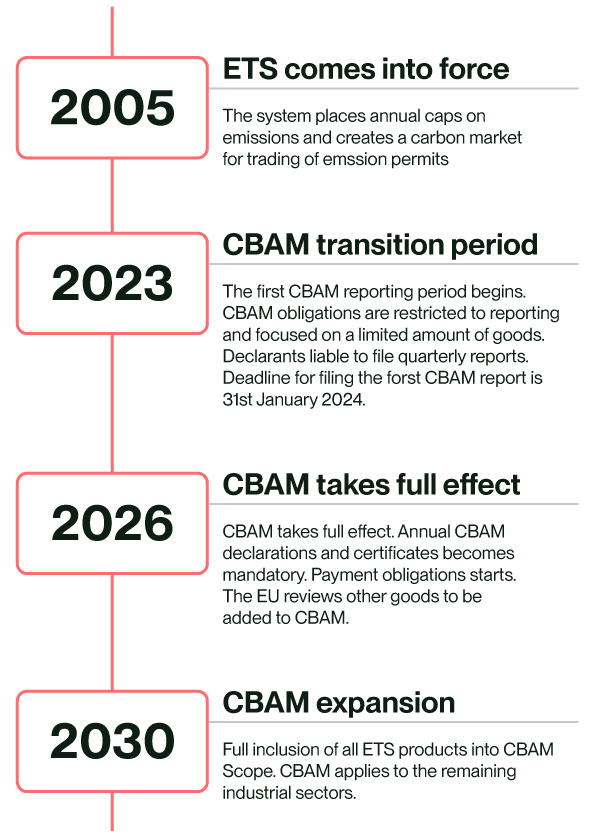
Following the conclusion of the transitional reporting cycle in December 2025, importers must now possess Authorised CBAM Declarant status to continue importing in-scope goods.
Registration must be maintained through the CBAM Transitional Registry (which continues to host the definitive phase data). In 2026, compliance requires third-party verification of embedded emissions data by an accredited verifier before the annual declaration is submitted.
The immediate steps organisations must take are to:
Non-compliance with can lead to significant consequences, including financial penalties, correction procedures, and fines. Penalties for non-compliance are strictly enforced in the definitive phase. Failing to report or providing inaccurate data carries fines of €10 to €50 per tonne of CO2. However, the National Competent Authority (NCA) can now apply significantly higher penalties if an importer operates without the mandatory Authorised CBAM Declarant status.
Under Regulation (EU) 2025/2083, the first annual certificate surrender is due by 30 September 2027. Authorized declarants who fail to surrender sufficient certificates by this date face a penalty of €100 per tonne of CO2, indexed to the European inflation rate. Importantly, paying the fine does not exempt the declarant from the obligation to surrender the missing certificates.
Since the start of 2023 the scope of this regulation has narrowed, removing previously proposed chemicals and polymers, but clarity has improved on the detailed nature of data reporting requirements. As of 2026, the CBAM scope remains focused on Iron, Steel, Aluminium, Cement, Fertilisers, Hydrogen, and Electricity. While organic chemicals and polymers were excluded from the initial launch, they are currently subject to a formal EU review for potential inclusion in the next expansion phase.
Surrender of the declared GHG emissions of products will be done through the purchasing of CBAM certificates, based on the EU ETS pricing. These certificates, instrumental in the carbon price framework, will be procured from a centralised platform overseen by the EC (European Commission). The fees linked to these certificates will be calculated by the EC, tethered to the conclusive proceedings of EU ETS allowances.
In the definitive phase, businesses face three primary cost drivers:
Since 1 January 2026, the mechanism has transitioned to a mandatory authorisation and annual reporting model. All imports above the 50-tonne threshold now require the importer to be an Authorised CBAM Declarant. Quarterly reports have been replaced by a single Annual CBAM Declaration, with the first submission for the 2026 period due by 30 September 2027.
The purchase of CBAM certificates is no longer a future expectation but a current financial accrual. Certificates are priced based on the weekly average auction price of EU ETS allowances.
The January 1, 2026 milestone marked the transition to the Definitive Phase. While the list of in-scope sectors (Iron, Steel, Aluminium, Cement, Fertilizers, Hydrogen, and Electricity) remains unchanged for now, the mechanism has shifted from a reporting exercise to a financially binding compliance regime.
As with all taxation systems, a CBAM impact assessment and road mapping is our recommended first step. Reporting is mandatory for some organisations, and later this will become taxed through certificates and will focus on scope and cost liabilities. The roadmap leads to deeper insights into supply chain dynamics, carbon measurement, and data collection, all tethered to the defined parameters within the Regulation, on a per product basis.
CBAM mandates organisations to embark on a comprehensive exploration of their supply chains. As a minimum, this entails understanding the origins of goods, but then collaboratively determining the GHG emissions associated with those products. This will involve a lot of data.
Annex II specifies 138 mandatory and 21 conditional data parameters. When considering each product in scope this quickly scales into a huge data-driven project desperately in need of a digital solution and automation.
Over the longer term, the financial lever of CBAM certificates will impact imported products. The data derived from reporting will also give a clear picture of the GHG footprint of where products are manufactured and where they end up being sold, helping to uncover the mystery of GHG further up the supply chain.
As CBAM moves into financial statements, we are seeing a shift toward cross-functional teams. Finance departments manage certificate procurement and liability accrual, while Sustainability and Procurement teams manage supplier data and verification audits.
Anthesis combines decades of GHG inventory expertise with specialized digital tools designed to navigate the CBAM Definitive Phase. While the regulation has moved into a financially binding era, our proven methodology for assessment, data verification, and compliance management ensures your business remains resilient to carbon-related trade barriers.
In 2026, we prioritise helping clients manage their Authorised CBAM Declarant status, verify primary supplier data to avoid penalising “default values,” and model the financial impact of EU-ETS price volatility on their certificate liabilities.
Our combined experience and library of carbon data makes us ideally placed to support clients in implementing new compliance systems for CBAM.
Don’t wait until the 2027 filing deadline to address data gaps. Secure your supply chain and manage your carbon costs today.


