SBTi Mandatory Reviews: Converting Compliance into Strategic Climate Performance

Why SBT five‑year reviews are the moment to stress‑test ambition, close the execution gap, and future‑proof targets

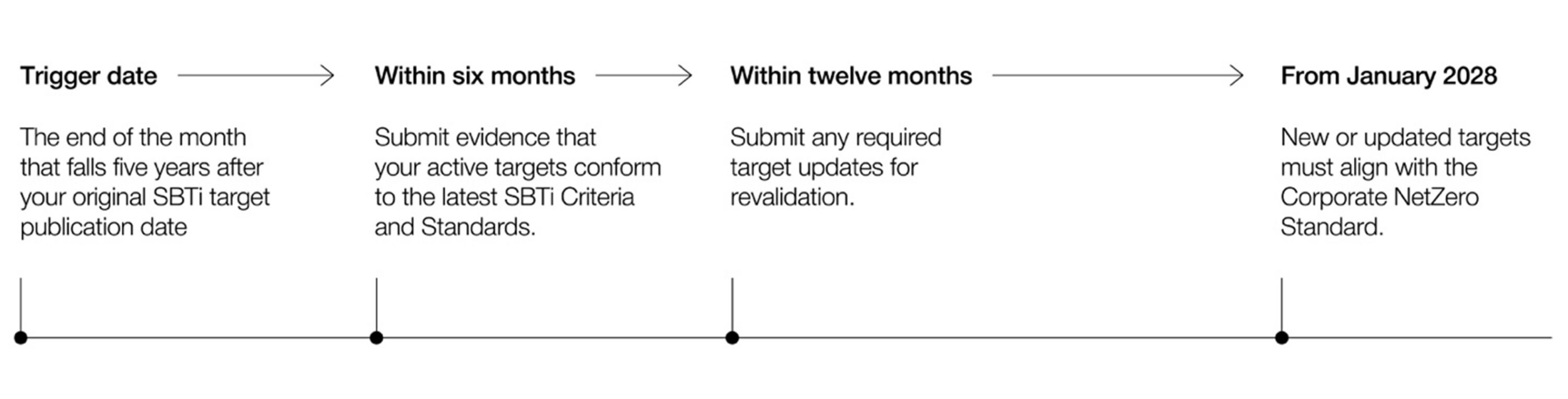
mandatory review timeline

Executive Director

North America

Five-year mandatory reviews are a formal part of the Science Based Targets initiative process. All companies with approved targets must review those targets against the latest SBTi Criteria every five years and, where needed, update and revalidate them. Early preparation is essential because evidence is due within six months of a company’s trigger date and the Corporate Net‑Zero Standard v2.0 will have implications for companies in the review process.    

What has changed and why it matters 

If updates are needed, they must be submitted to SBTi Services within six months of the evidence date. Companies approaching their target year may request an extension so that the review aligns with their next target-setting cycle.  

From January 2028, the prevailing SBTi Criteria will be the Corporate NetZero Standard V2.0 (CNZS V2.0), which will apply to any new targets and to targets undergoing a mandatory review. SBTi has indicated that a final version of the standard is expected by mid 2026. Once it is published, companies will have the option of using the current criteria or updating their targets to align with CNZS V2.0.  Organisations with mandatory review trigger dates in 2027 should factor this transition into their review strategy now.  
Mandatory review is an opportunity to do more than check a box. It is a chance to pressure test targets against the latest science, prepare for the latest NetZero Standard, and strengthen the link between ambition and delivery. Teams that start early will avoid bottlenecks and convert compliance into measurable value.

Melissa Donnelly, Associate Director, Anthesis 

Mandatory review timeline at a glance

Making the review work for business, climate and nature 

The review is a practical moment to: 

  • Close the execution gap by aligning decarbonisation pathways with operational constraints, investment cycles and supply chain realities. 
  • Integrate enterprise risk by assessing climate and nature dependencies and impacts across boundaries, data quality and methodologies. 
  • Focus capital credibly by sequencing abatement, regeneration and circularity interventions that deliver both emissions reductions and nature positive outcomes. 

Annual internal checks remain good practice. The five-year review is the point to revisit system boundaries, data sources, methodologies and material business changes that may trigger updates under the latest SBTi Criteria.  

How Anthesis can help 

As expert guides, Anthesis has supported hundreds of organisations to design, validate, update and operationalise science-based targets across sectors and geographies. Our Climate & Nature Centre of Excellence is tracking the development of the final NetZero Standard V2.0 and translating the implications for programme design and delivery.

We help clients to:  

  • Complete a mandatory review assessment against the latest SBTi Criteria  
  • Run a gap analysis of near-term and as relevant, long-term targets, including boundary, data and methodology checks.  
  • Prepare and submit the evidence form within the six-month window.  
  • Recalculate and redesign targets where required, with clear governance and implementation plans that close the execution gap.  
  • Plan the transition to the NetZero Standard, weighing the benefits of maintaining under current criteria through 2027 versus moving early to futureproof ambition.  

Our approach offers breadth and depth simultaneously. We provide a detailed understanding of the SBTi criteria and nuances, while also having a keen eye to a company’s overall climate strategy. When the NetZero Standard V2.0 is published midyear, it will become the rulebook, and we’re already partnering with our clients to scenario plan on their existing target so they are set up to deliver durable emissions reductions and nature positive outcomes across their value chains.

Emma Armstrong, Executive Director, Anthesis 

Practical next steps 

  1. Mark your trigger date and work back to create an internal timetable to evidence gathering, governance and SBTi submission.
  2. Run a rapid compliance check to decide whether any targets will likely require updating and what level of recalculation is warranted.  
  3. Define your transition strategy for the Net‑Zero Standard and prepare scenarios so you can respond quickly when the final version is published.  

Contact our SBTi specialists to discuss timelines, evidence preparation and the best route to target longevity and impact.