Investing in Tomorrow: Exploring the Nature Repair Market
16 March 2026

16 March 2026

Governments and businesses are finally starting to focus on the importance of nature and its restoration. Nature and its ecosystems, sometimes referred to as natural capital, are being rapidly depleted and remain critically undervalued in financial and corporate decision-making. To change this status quo globally, financial mechanisms, such as nature markets, are being explored with the hope of driving more investment towards natural capital, nature restoration and nature repair.
In Australia, the government introduced the ‘Nature Repair Market Bill’ in early 2023. After months of negotiation, it passed through parliament in December 2023, creating the first-ever national voluntary framework for a nature market. The Nature Repair Market is now a national, legislated biodiversity market designed to deliver high‑integrity biodiversity outcomes and increase private investment in nature. Here we explore what the Nature Repair Market is, why do we need it, what biodiversity certificates are, who will use the market, and how the market and biodiversity certificates will be used by investors and corporate organisations.
The Nature Repair Market aims to encourage and facilitate private finance towards the preservation and restoration of Australia’s unique natural environment, thereby boosting national investment in halting biodiversity decline and rejuvenating nature. It equally seeks to incentivise landholders for their efforts in conserving biodiversity.
The Nature Repair Market allows registered projects to generate tradable, government-backed Biodiversity Certificates connected to biodiversity preservation and restoration activities. Voluntary buyers can purchase these certificates to meet their nature positive targets and demonstrate investment in Australia’s biodiversity.
The Market is voluntary and regulated by the Clean Energy Regulator (CER), which has monitoring and enforcement powers. Projects will be required to meet regulations and monitoring, reporting and verification requirements regarding the implementation of project activities and delivery of environmental outcomes.
The market is supported by integrity settings, including:
The Nature Repair Market forms part of the government’s Nature Positive Plan and is intended to facilitate the significant natural capital investment necessary for Australia to meet its goal of protecting 30 per cent of our land and 30 per cent of our oceans by 2030.
On the demand side, interest in nature repair investment is anticipated from various stakeholder groups. Trends in the carbon market show participants are increasingly seeking credits from projects that not only address carbon-related concerns but also deliver benefits to the broader natural environment. Environmental, Social, and Corporate Governance (ESG) strategies are also anticipated to drive demand in the nature repair market, as are corporate commitments made through new reporting frameworks currently gaining momentum, such as the Taskforce for Nature-Related Financial Disclosures.
Eligible participants include landholders, First Nations organisations, conservation groups, farmers and other project proponents, provided the project meets method requirements and CER registration criteria. Investors may partner with proponents to fund project establishment, or purchase biodiversity certificates
Projects can be developed on land, within inland waterways (such as lakes and rivers), in marine and coastal areas on the Australian mainland or external territories. Projects may include:
Landholders can also engage in initiatives to preserve current habitats, rehabilitate and improve degraded areas and create new plantings to support biodiversity and animal habitats.
The first approved method is the Nature Repair (Replanting Native Forest and Woodland Ecosystems) Methodology Determination 2025, which sets out the rules for projects that involve the revegetation of historically cleared land and the replanting of local native vegetation to support ecological connectivity. This method is supported by the Biodiversity Assessment Instrument (BAI), which defines how biodiversity must be measured and described in projects.
Further methods are being developed, including methods for enhancing native vegetation and protecting and conserving existing biodiversity.
To participate, proponents must:
The market is supported by several government data and assessment tools, including:
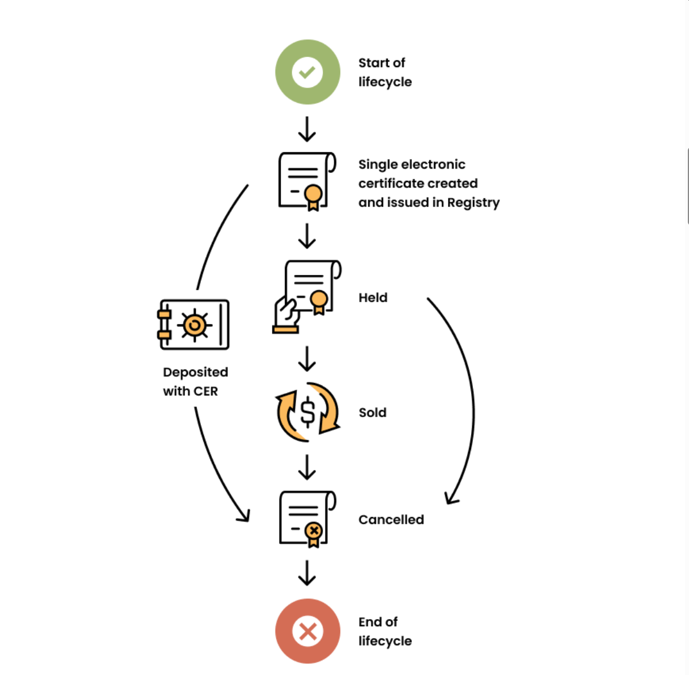
The Act states “A biodiversity certificate represents the biodiversity outcome that a registered biodiversity project is designed to achieve. Biodiversity certificates are the property of their registered holders, and may be transferred.”
Each project has a single tradable biodiversity certificate. Owners can sell these certificates to buyers under commercial contracts.
Tracking certificates, their status, and ownership happens through the public Biodiversity Market Register. This registry keeps records of all registered biodiversity projects and certificates and helps certificate owners demonstrate their support for nature repair.
Biodiversity certificates provide clear information for easy comparison and valuation of projects within the market. Regular project reports will describe and confirm environmental outcomes.
Certificates are traded through the National Stewardship Trading Platform, linking landholders and private buyers of biodiversity and carbon outcomes. The marketplace enables users to share information, contact listing owners, and negotiate commercial deals directly once connected. Registered users can create public project listings displaying environmental offerings or needs.
Acquiring biodiversity certificates through the Nature Repair Market should give businesses and investors a solid foundation for their ‘green claims’ on nature repair projects. With this new market, organisations can explore opportunities to pursue a nature-positive strategy and meet stakeholder expectations regarding biodiversity risk management.
Having easier access to reputable biodiversity projects can help businesses fulfill their ESG objectives and invest in nature-positive impacts. With increasing scrutiny on greenwashing, there’s an increased expectation from stakeholders for businesses to take action against biodiversity loss.
No. It is important to note that the initial bill included language around the use of the certificates for offsets, however, the Bill that passed parliament states:
76A Biodiversity certificates not to be used for environmental offsetting purpose
(1) A biodiversity certificate must not be used for an environmental offsetting purpose.
(2) This section has effect despite any other provision of this Act or any other law of the Commonwealth, or a State or Territory.
(3) To avoid doubt, section 225 (Concurrent operation of State and Territory laws) does not apply to this section.
Note, following the environment protection reforms (28 November 2025), methods may specify whether biodiversity certificates can be used as environmental offsets, subject to further requirements in the Rules.
The Bill ensures the integrity, enforcement, and genuine environmental impact of projects. For each registered biodiversity project, a methodology determination is mandatory. Proposed methodologies undergo a review by the Nature Repair Committee, incorporating compliance requirements and biodiversity integrity standards. These standards will guarantee that projects generate authentic nature improvements.
Regulation of the market falls under the Clean Energy Regulator, equipped with monitoring and enforcement authority to oversee compliance with the established regulations. This involves monitoring, reporting, and notification of project activities and environmental progress.
There is a possibility that at some point, Australia’s Nature Repair Market could intersect with the TNFD, as both seek to align financial flows with nature-positive outcomes and to increase transparency and accountability on nature-related issues.
How will the Nature Market align with the Carbon Market?
The market will run in parallel with carbon markets. The Department of Climate Change, Energy, the Environment and Water states that landholders will have the opportunity to acquire certificates from carbon projects that simultaneously enhance biodiversity. The oversight by the Clean Energy Regulator aims to align the markets, facilitating an easier process for landholders to participate in both schemes.
The World Economic Forum estimates that over half of the world’s GDP – or approximately US$44 trillion of economic value – is moderately or highly dependent on nature (World Economic Forum).
We all rely on natural capital: oceans, minerals, ecosystems, andthe atmosphere. We also heavily depend on services natural capital provides, like fuel, food, fibre, medicines, and services like water filtration, erosion control, and climate regulation. However, most of these services provided by nature are unpriced or economically invisible. The invisible, and yet unaccounted for, dependencies on natural capital possess significant unmanaged risks and stability for communities around the world and also businesses.
At the United Nations Biodiversity Conference (COP 15) in December 2022, over 190 countries (including Australia) agreed to the Kunming-Montreal Global Biodiversity Framework (GBF). Historic in its ambition to commit nations to protect 30 per cent of the earth by 2030 (30×30), the COP15 agreement is consequential for business, with its 23 voluntary targets including goals to stem the risks that biodiversity loss poses to the global financial system (Convention on Biological Diversity).
On the back of this growing momentum, governments and businesses are increasing their focus on natural capital and nature repair.
The Innovative Biodiversity Monitoring Grants Program has already been established by DCCEW to encourage innovative and cost-effective solutions for biodiversity monitoring, with the aim of supporting the delivery of environmental outcomes from the Nature Repair Market. Determining the financial support and/or monetisation of credits for these projects will be the next crucial step.
Australia’s Nature Repair Market stands as a pioneering initiative, representing the world’s first voluntary biodiversity market. Its development holds the promise of significantly expanding Australia’s capacity to garner broader support for a future that prioritises nature positivity and has the potential to be a transformative force for biodiversity and the conservation of natural capital.
By encouraging voluntary participation, the Nature Repair Market in Australia aims to redefine the landscape of conservation efforts, presenting an innovative model that can serve as a global example for sustainable practices and the preservation of biodiversity.
Our team are experts in identifying cost-effective and impactful nature-based solutions, that protect, sustainably manage, and restore natural capital and modified ecosystems. If you have questions about the Nature Repair Market or want to explore how we can support your nature initiatives, reach out to us today with yoru questions on the nature repair market and to learn more about how we can support your nature initiatives.
Article originally published December 2023 – updated March 2026




We are the world’s leading purpose driven, digitally enabled, science-based activator. And always welcome inquiries and partnerships to drive positive change together.