Why NGER reporting looks different under ASRS

Key takeaways:
For many organisations, reporting under the National Greenhouse and Energy Reporting (NGER) scheme has been treated as a discrete compliance process. It has typically sat with sustainability or operational teams, focused on reporting facility-level emissions in line with legislated methods. That framing no longer reflects the role NGER data now plays.
With the introduction of the Australian Sustainability Reporting Standards (ASRS), and in particular the Australian Accounting Standards Board’s (AASB) published standard “AASB S2” (Climate-related Disclosures), NGER data now sits at the centre of corporate reporting. Organisations need to reframe processes built for regulatory compliance to meet capital market expectations. Emissions are disclosed alongside financial information, assessed through materiality, and increasingly subject to external assurance.
AASB S2 doesn’t require organisations to abandon NGER, it can be used under “jurisdictional relief”. However, it is not sufficient on its own to meet broader greenhouse gas disclosure requirements.
As a result, most organisations are working in two directions at once. They need to extend beyond NGER to address gaps, particularly across the value chain Scope 3 emissions under ASRS, while strengthening governance and controls around existing NGER processes to support assured, decision-useful reporting.
This section sets out the context underpinning AASB S2, clarifies what jurisdictional relief allows, and highlights the key differences across methodology, timing, assurance and penalties.
AASB S2 requires a broader set of disclosures beyond greenhouse gas emissions that many organisations have not yet fully addressed.
Priorities for reporters to address include:
Recognising that emissions are only one component, other disclosure areas rely more heavily on judgement, take longer to develop, and require broader input across the business.
For more details about the climate-related disclosures under AASB S2, read our guide to climate-related financial disclosures here.
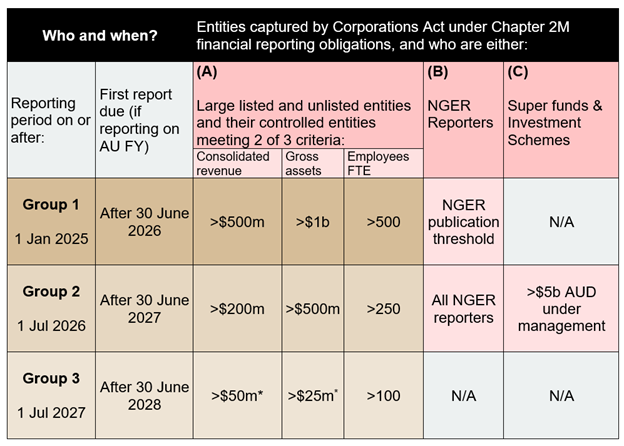
Note for Group 3 cohort: In the 2026-27 Budget, the Australian government announced potential legislative reform to increase the threshold for large proprietary companies from $50m to $100m of consolidated revenue and $25m to $50m of consolidated gross assets. More details Budget 2026–27 Fact Sheet.
“Jurisdictional relief” is not explicitly defined in AASB S2, but is commonly used to describe provisions that allow entities to apply locally mandated emissions measurement approaches in place of the GHG Protocol.
In the Australian context, this is particularly relevant to NGERs. The scheme prescribes how emissions are measured and reported, providing an established regulatory basis for Scope 1 and Scope 2 data.
The concept originates from IFRS S2 which AASB S2 is based on. It was introduced to support adoption in jurisdictions with existing reporting frameworks, recognising that requiring full recalculation under the GHG Protocol would duplicate effort where credible schemes such as NGER already exist.
Recent amendments provide further clarity for NGER reporters.
On 15 December 2025, the AASB announced amendments titled AASB S2025‑1, which clarified the application of jurisdictional relief. Most notably, the amendments explicitly confirmed that:
Hence, entities are limited in applying NGER to their GHG emissions to the extent those requirements apply – you aren’t excluded from other disclosures not covered by NGER (e.g., Scope 3 emissions).
In practice:
One of the most immediate challenges for entities reporting under both frameworks is timing. Under the NGER Act, registered corporations must submit their NGER report by 31 October following the end of the reporting year.
By contrast, sustainability disclosures prepared under AASB S2 form part of the entity’s annual financial reporting package, which is typically required to be lodged within 3-4 months of the year-end.
This creates a sequencing issue:
Entities should expect to allow more time for NGER-aligned data collection, estimation and validation processes to support earlier reporting deadlines and assurance under AASB S2.
A second key point of divergence is assurance expectations.
Historically, NGER reporting has included less external verification, and has been caused by high emissions facilities (greater than 1M tCO2e) or audits triggered by the Clean Energy Regulator (CER).
Climate disclosures now form part of a statutorily defined sustainability report under the Corporations Act 2001, which consists of climate statements, notes, and the directors’ declaration about the statements and the notes.
Under the existing Chapter 2M framework these are pulled into the scope of assurance, where a phased assurance approach has been established by the Auditing and Assurance Standards Board (AUASB).
The phasing starts at limited assurance and increases to reasonable assurance over subsequent years. Limited assurance does not imply low expectations; it still requires that disclosures are free from material misstatement and supported by appropriate evidence and documentation. Emissions data derived from NGER processes must now meet audit-quality evidence thresholds, including:
NGER processes that were previously fit for regulatory purpose may require uplift to achieve a standard capable of audit scrutiny.
Consequences of errors in emissions reporting also increase under AASB S2.
Directors must make a declaration that, in their opinion, the substantive provisions of the sustainability report are in accordance with the Corporations Act (including that they are made in accordance with ASRS).
Lodging false or misleading climate statements could lead to penalties of approx. $15M or 10% of turnover.
Directors and officers face personal liability – in the most serious of cases, this could involve imprisonment, financial penalty of approx. $1.5M or disqualification orders.
What this means in practice
NGER remains a necessary foundation, but it does not meet the level of scrutiny and assurance required under broader ASRS disclosures.
Jurisdictional relief allows the continued use of NGER methodologies…
“for the part of the entity to which that requirement applies…” (AASB S2, B24)
However, it does not remove the obligation to ensure that disclosures are complete, consistent and decision-useful across the full reporting boundary.
Many organisations are using structured reviews to identify where existing NGER practices do not yet meet ASRS governance and assurance expectations, and to confirm that NGER data is current, complete and defensible. Reviews such as the Anthesis NGER Health Check provide a practical way to test data quality, controls and readiness ahead of ASRS disclosure.
Learn more here – NGER Health Check: Strengthening NGER Data Integrity And Reporting Confidence | Australia
Anthesis has supported many of Australia’s largest organisations to prepare for AASB S2 and has worked with NGER reporters for over a decade. We bring deep technical expertise and extensive global experience, helping organisations develop credible, decision‑useful disclosures. Call us for a chat on +61 3 7035 1740 to find out more, or to lock in a Health Check, reach out to our experts via email or the form below
We are the world’s leading purpose driven, digitally enabled, science-based activator. And always welcome inquiries and partnerships to drive positive change together.


