Product Footprints at Scale
Digitally enabled LCA and PCF at scale to meet customer requirements, support sustainability reporting, and inform better product decisions.
Anthesis helps organisations scale Life Cycle Assessment (LCA) and Product Carbon Footprint (PCF) by creating repeatable processes for decision-ready product life cycle data, regardless of portfolio size and complexity.
Product-level environmental data is increasingly needed to respond to customer requests, support reporting requirements, and inform product and supplier decisions. Using readily available product, supplier, and operational data as a starting point, Anthesis works with clients to build practical LCA and PCF capabilities that can expand and improve over time. We focus first on producing credible, useful results, then help organisations identify where additional data and analysis will create the greatest value.
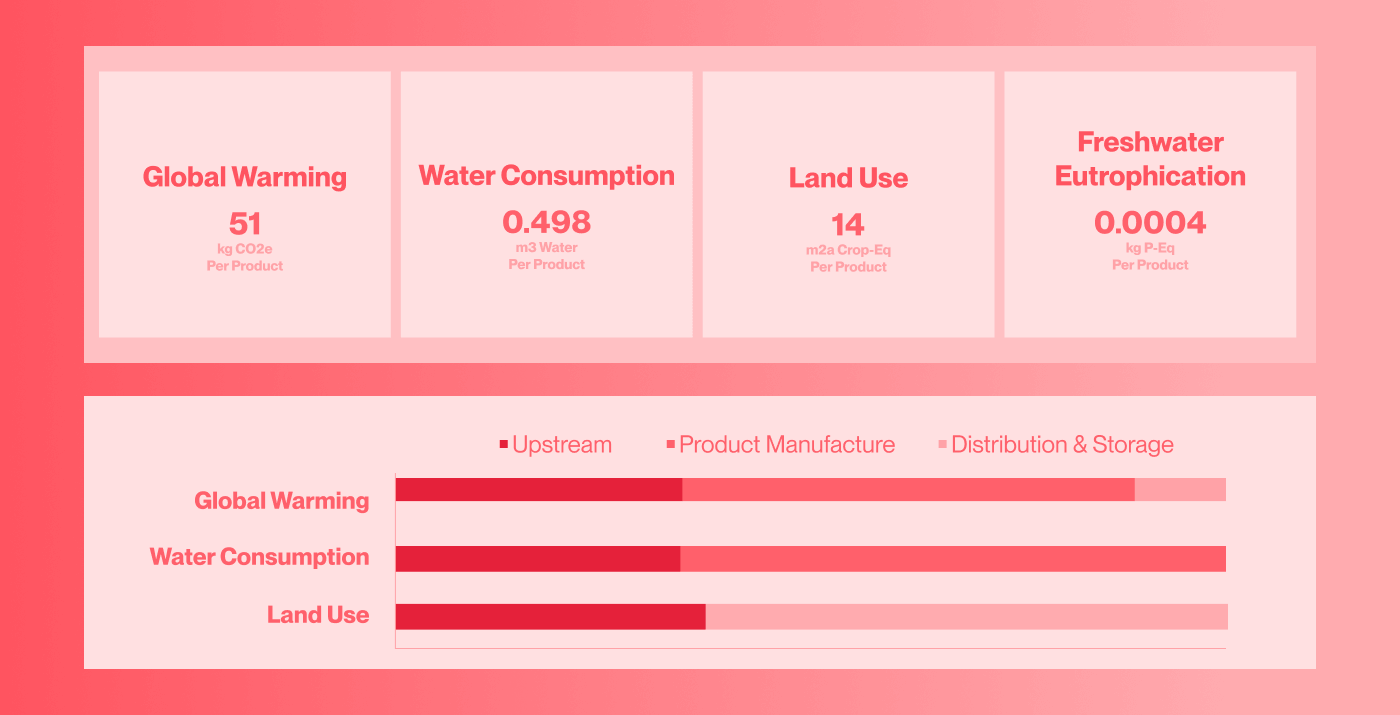
Provide consistent product-level environmental information to customers, procurement teams, and business partners. This information can also be disclosed proactively to customers to differentiate based on product performance and reporting transparency.
Scale LCA and PCF across large product portfolios, complex product structures, and global supplier networks
Leverage a flexible combination of digitally-enabled processes, expert LCA advisory, and delivery support to standardise repeatable work, reduce internal effort, and focus teams on higher-value decisions including product design, supplier engagement, and Scope 3 improvement.
Use product-level environmental data to identify hotspots, evaluate alternatives, and inform product decisions.
Link product footprints with corporate footprints, supply chain engagement, reporting, and disclosure activities.
Support decision-making through transparent methodologies, expert oversight, and ISO-aligned approaches designed for portfolio-scale application.
Talk to our team about your products, data, customer requirements, and goals. We’ll help you identify an approach that fits your current needs and resources.
LCA and PCF at Scale applies Life Cycle Assessment and Product Carbon Footprinting approaches across numerous products rather than individual products. LCA and PCF at Scale leverages consistent methodologies, assumptions, and modelling approaches across product portfolios as opposed to carrying out each assessment as a separate exercise. This enables organisations to expand coverage, improve consistency, and make better use of existing product data while maintaining appropriate expert oversight.
A Product Carbon Footprint (PCF) (also referred to as CFP, or Carbon Footprint of Products) focuses specifically on greenhouse gas emissions associated with a product throughout its life cycle and is typically reported as a carbon footprint. A Life Cycle Assessment (LCA) takes a broader view, evaluating a range of environmental impacts such as climate change, water use, resource depletion, and other impact categories. PCFs are often used to respond to customer requests, reporting requirements, and decarbonisation initiatives, while LCAs can provide a more comprehensive understanding of a product’s environmental performance and improvement opportunities and can help to avoid environmental trade-offs or shifting of burden from one impact to another by choosing from 18 environmental impact factors.
LCAs and PCFs are typically developed using a combination of product, supplier, and operational data. This may include bills of materials (BoM), full material disclosure (FMD), product or technical specifications, purchasing records, manufacturing data (e.g., energy and water use), supplier information, and existing corporate emissions data. While primary supplier data can improve accuracy, organisations do not need perfect data to get started. At a minimum, many organisations can begin with a bill of materials, product specifications, and a basic understanding of manufacturing processes. This information can be supplemented with secondary datasets and refined over time. As programmes mature, data quality and coverage can be enhanced by prioritising the products, suppliers, and data gaps that have the greatest impact on results.
Not necessarily. The right approach depends on your objectives, customer requirements, and product portfolio. Some organisations begin by focusing on priority products based on customer demand, revenue, strategic importance, or environmental impact. Others take a portfolio-based approach that uses common methodologies, existing product data, and scalable processes to expand coverage over time. These assessments help organisations identify where product-level information will provide the greatest value and build a practical roadmap for broader coverage.
LCA and PCF can help strengthen Scope 3 emissions reporting by providing more product- and supplier-specific environmental data and reducing reliance on broad spend-based estimates and industry-average emission factors. By understanding the emissions associated with products, materials, and suppliers, organisations can improve emissions visibility across their value chain, identify hotspots, support supplier engagement activities, and track progress over time. Product footprint data can also help organisations gain commercial advantages by responding more effectively to customer requests while supporting wider decarbonisation and reporting objectives. Anthesis Intelligence Product Footprints can be connected with Corporate Footprints, Supply Chain, Reporting & Disclosure, and client systems to support a more integrated sustainability data strategy.
Expectations vary by region and by sector, but customer demand for product-level environmental information continues to grow. Increasingly, organisations are requesting information across broad product portfolios rather than a small number of flagship products. They are also seeking greater transparency, consistency, and confidence that product footprints reflect actual products, suppliers, and operations. LCA and PCF are generally seen as the accepted way to communicate this information.
Anthesis provides our clients with comprehensive access to the Product Footprints software. Unlike many other Product Carbon Footprint or Life Cycle Assessment software tools, Anthesis allows for unlimited users/seats and assessments in our tool. That means you can run multiple scenarios or variations of product designs and see the impact of these in real time. The Product Footprints software also has built-in automated reporting with your company branding, meaning every assessment you create comes with a customer-ready PDF report and access to all of the assessment data for your internal use.
The Anthesis Intelligence Product Footprints software is externally verified for alignment with ISO 14040 and ISO 14044.
This provides added confidence in using the results to:
Whether responding to regulatory requirements or driving sustainability-led product innovation, Anthesis Intelligence offers an even stronger base for trusted, defensible insights.
Our intelligent material matching capability (Expert-Led Intelligent Dataset Matching) helps sustainability experts align client-specific material and product descriptions with relevant life cycle inventory and emission factor datasets. Rather than replacing expert judgement, we automate the identification of suitable dataset candidates, enabling experts to review, validate, and refine recommendations more efficiently. This expert-led approach improves consistency, reduces manual effort, and accelerates the delivery of robust product carbon footprint and life cycle assessment studies while maintaining transparency and methodological rigour.