Nature Action Just Got More Practical: What the Latest NPI, TNFD and SBTN Updates Mean for Your Business



Three major framework updates have raised expectations on how businesses assess and respond to nature-related risk. This piece covers what has changed and what it means for business.
About half of global GDP, around US$58 trillion depends on nature. Yet the natural systems behind that value are in steep decline. WWF’s 2026 Living Planet Report found that monitored populations of mammals, birds, fish, reptiles and amphibians fell by an average of 73% between 1970 and 2022.
This nature loss is increasingly affecting business performance. Every organisation depends on nature and has an impact on it. Declining ecosystem health can disrupt supply chains, increase operational challenges and create uncertainty across markets. Nature loss is now an operational, financial, regulatory, reputational and supply chain risk.
Until recently, many companies struggled to navigate the growing number of nature-related frameworks, metrics and expectations. Understanding nature-related impacts and dependencies was one challenge and turning those insights into action was another. Recent updates are making that process clearer.
The nature agenda is moving on from awareness and commitments to implementation.
IPBES’ 2026 Business and Biodiversity Assessment sets out more than 100 actions that businesses, governments, financial actors and civil society can take to understand, measure and respond to their impacts and dependencies on nature. One of the clearest is to use established frameworks to assess and report nature-related impacts, dependencies, risks and opportunities.
Those frameworks are now becoming increasingly aligned. Recent updates from the Nature Positive Initiative (NPI), the Taskforce on Nature-related Financial Disclosures (TNFD) and the Science Based Targets Network (SBTN) are more practical and better aligned than ever. Seen together, they form a joined-up journey:
With nature also becoming part of mainstream financial reporting, including through emerging ISSB guidance, this alignment means less duplication, clearer priorities and a more credible case for investment.
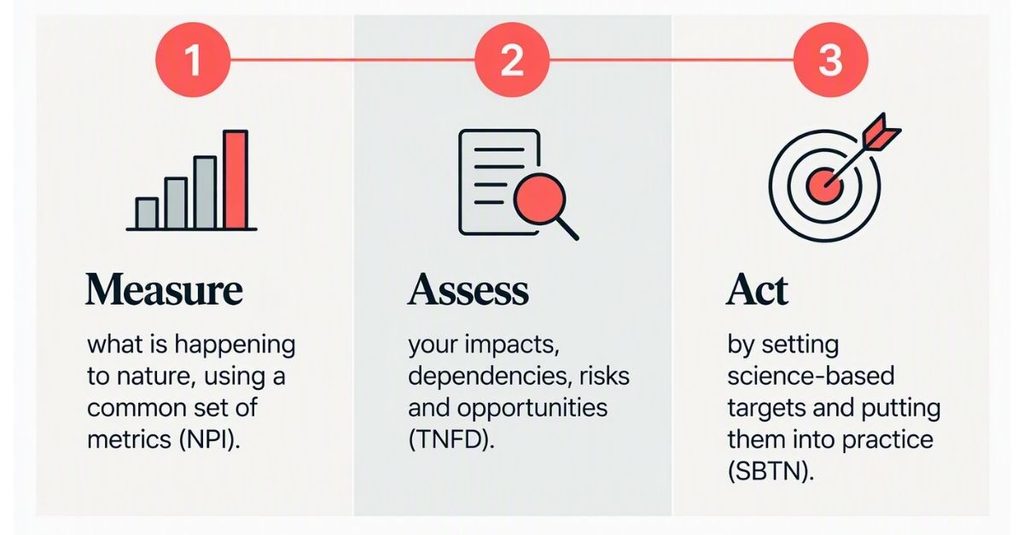
One of the biggest barriers to nature action has been measurement. With hundreds of different metrics in use, it has been hard to compare results or know whether action is working.
The Nature Positive Initiative’s new State of Nature framework tackles this head-on. Developed over two years with scientists, businesses, financial institutions and nature experts, it streamlines more than 600 existing metrics into four core indicators:
The framework offers guidance for different levels of data and rigour, using both public datasets and company data. It is aligned with the Global Biodiversity Framework and designed to support TNFD, SBTN and GRI.
Why it is important: State of Nature metrics answer the question that matters most: is nature actually recovering as a result of what we do? A shared set of outcome measures gives companies and financial institutions a consistent way to track performance, compare risk and direct capital to where it will make a real difference.
For many organisations, TNFD’s LEAP approach (Locate, Evaluate, Assess, Prepare) is the starting point for understanding their relationship with nature. TNFD has now released LEAP 2.0, making assessments more robust and easier to align with other frameworks.
The biggest changes include:
TNFD is also supporting a new ISO standard for LEAP, expected in 2028, continuing its work with the ISSB on reporting requirements, and updating its interoperability mapping with the European Sustainability Reporting Standards (ESRS).
Why it is important: LEAP is becoming the practical backbone of nature risk assessment and disclosure. With TNFD, SBTN, NPI, ISSB and ISO pulling in the same direction, companies can do the work once and use it many times, rather than repeating assessments for different frameworks.
Setting science-based targets for nature has often felt out of reach, particularly for companies with imperfect data, limited traceability or complex value chains. SBTN’s updated guidance, Science-based Targets for Nature 2.0, is shaped by years of consultation with partners and companies and is designed to change that.
What’s new:
There is also growing evidence that this effort pays off. SBTN and the Accountability Accelerator’s report, Step Up for Nature: The Business Case for Science-Based Targets, draws on 14 case studies across food and beverage, fashion and textiles, construction and energy, packaging and printing, and pharmaceuticals. Companies reported better use of resources, stronger supplier engagement, greater credibility with stakeholders, more effective governance and more confidence about where to act.
Why it is important: SBTN provides a clearer pathway from assessment to action. While science-based targets can support regulatory preparedness, they can also help organisations make more informed decisions about risk, resilience and long-term value creation.
Taken together, these updates send a clear message: the tools for nature action are maturing, converging and becoming more practical. Companies no longer need to wait for perfect data or a settled landscape to make progress.
Where to start:
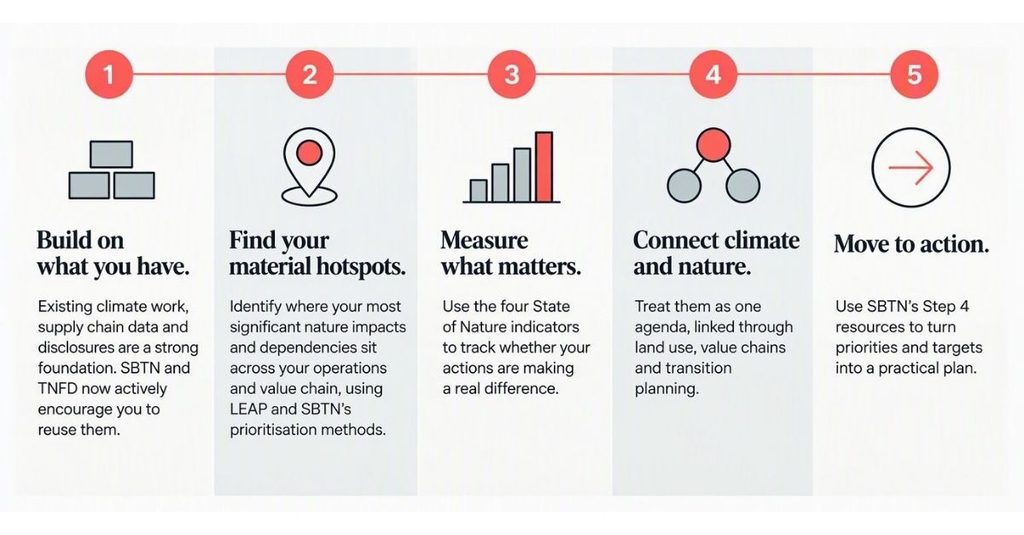
Anthesis helps organisations turn nature ambition into practical action. Building on our extensive experience across both climate and nature, we help you understand how biodiversity, climate, land use and value chains connect, and what that means for your business.
Our multidisciplinary team brings together expertise in ecology, biodiversity, nature risk and geospatial analytics. We help you pinpoint where your most material nature-related issues occur, understand what they mean for your business and decide where action will have the greatest impact. That gives you a strong foundation for:
Learn more about our nature solutions
Ready to take the next step? Get in touch with our nature team to find out how these updates apply to your organisation.
Anthesis supports companies globally to prioritise, measure and act on nature. We’d love to talk about how we can support you.