The Australian Government’s introduction of mandatory climate-related financial disclosures legislation under the Australian Sustainability Reporting Standards (ASRS), mean transparency and accountability in climate-related reporting are now mandatory for a large cohort of Australian businesses.
Is your organisation prepared to navigate the complexities of the new Australian Sustainability Reporting Standards (ASRS) AASB S2 and comply with mandatory climate-related disclosures?
What are the Australian Sustainability Reporting Standards (ASRS)
The new Australian Sustainability Reporting Standards (ASRS), are aligned internationally with the ISSB Standards, and will redefine corporate responsibility in Australia. The standards are sometimes referred to as Mandatory Climate Disclosures (MCD) or Mandatory Climate Reporting (MCR).
The standard AASB S2 mandates comprehensive reporting on climate-related financial information, including climate risks, opportunities, and GHG emissions. By enhancing transparency and accountability, they will ensure that sustainability is integral to corporate strategy and operations, supporting Australia’s emission reduction targets.
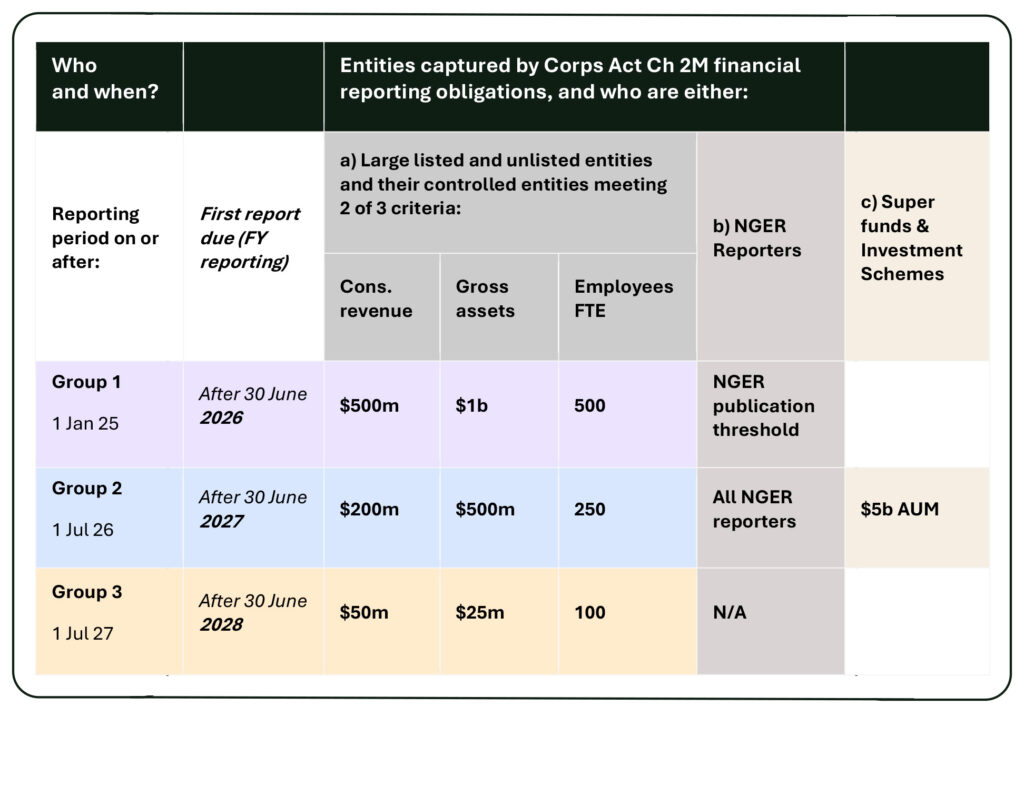
The mandatory climate disclosures to ASRS impact a wide range of entities, including the following. It is essential to determine early on whether your business falls under these categories to ensure timely compliance with the new standards.
How to Prepare for Mandatory Climate Disclosures to AASB S2 under the ASRS
Risk and Governance Assessment: Ensure your governance framework robustly manages climate risk. Begin by assessing your current risk profile and governance to align with ASRS requirements.
Skills and Capabilities Review: Evaluate your internal capabilities to meet these disclosures. Where necessary, seek to bridge knowledge gaps through training or hiring, ensuring your team is up to speed with the latest in climate risk management.
Action Plan Development: Develop a comprehensive action plan to address any compliance gaps. Set clear milestones and deadlines to achieve ASRS readiness before 2025.
How we Support Clients with AASB S2 Readiness
Our sustainability and climate risk specialists help organisations understand and implement effective climate risk assessments, strategies and climate‑related reporting. We support businesses at every stage of their disclosure journey and align with ASRS standards, including AASB S2 and S1, as well as ISSB, ESRS, CSRD and leading ESG frameworks such as the Global Reporting Initiative.
For more than a decade, we have been focused solely on climate, helping many of the world’s largest companies. We are not newcomers. Our team combines deep technical expertise with an assurance lens that helps clients build confidence in their disclosures and meet new mandatory reporting requirements with clarity and rigour.
We apply specialist climate knowledge to help you manage risk, identify opportunity and strengthen your business. Our approach emphasises efficiency, stakeholder value, increased resilience and measurable positive impact for the short and long term. We help you generate decision‑useful information, uncover opportunities for value creation and build stronger insight and governance that support sustainable performance across your organisation.
We also bring cross‑functional teams together, strengthening collaboration across finance, risk, sustainability, executive leadership and operations to support a smoother, more aligned and effective reporting process that goes well beyond compliance. It helps anchor climate disclosures within your broader business strategy, guiding smarter decisions, clearer priorities and stronger organisational performance.
Mandatory Reporting | ASRS Webinar Series
In this webinar series, our experts explore in detail the key elements of the ASRS standards and offer practical tips for everything you need to know to prepare for reporting, answer your questions and explore the opportunities that exist beyond compliance to drive innovation, efficiency, sustainable performance and business value.
Mandatory Climate Disclosures | ASRS Support Services include:
End-to-end support or a modular approach, to prepare you to achieve compliance-grade climate-related financial disclosures aligned with ASRS, ISSB and CSRD standards.
Training and upskilling your team, including exec level, plus governance uplift.
Developing strategies for climate mitigation and adaptation, and establishing metrics and targets.
Qualitative and quantitative scenario analysis to assess the financial impacts of climate-related risks and opportunities (CRROs).
Greenhouse Gas (GHG) emissions inventories including full value chain scope 3 accounting based on NGER methodologies, GHG Protocol and financed emissions measurement using PCAF framework.
Developing Climate Transition Plans.
Advising and reporting on nature-related risks and opportunities aligned to TNFD or the AASB S1 standard.
Useful, practical and decision‑ready support that identifies efficiency gains, drives innovation and strengthens long‑term resilience and sustainable performance – beyond compliance.
Anthesis Intelligence – digital tools for ASRS disclosures
Anthesis Intelligence – digital tools for preparing for ASRS and AASB S2, which can support your gap analysis, scope 3 inventory, reporting and more from an audit-ready perspective. Learn more and reach out for a demo.
Anthesis were extremely professional and knowledgeable and effectively led our team in our updated Climate Risk and Opportunity Assessment. The final deliverables were of high quality and user friendly. Plus their team was great to work with.
Rob Mackie, (ex) Head of Sustainability Viva Energy.
We work with ambitious leaders who want to define the future, not hide from it. Together, we achieve extraordinary outcomes.
Contact us for a complimentary advisory call to discuss assistance with your sustainability initiatives and climate -related assessment and reporting.