CSRD Scope 3 Reporting
Mandatory requirements and how to comply

Mandatory requirements and how to comply
In this article, we explore the link between Scope 3 and CSRD, how Scope 3 mandatory reporting impacts businesses and how to navigate the corporate value chain.
Yes. Under the Corporate Sustainability Reporting Directive (CSRD), Scope 3 reporting is mandatory for all in-scope companies where value chain emissions are material. This is governed by the European Sustainability Reporting Standards (ESRS) – specifically ESRS E1 on climate change – which require companies to disclose indirect emissions across both upstream and downstream activities. Unlike previous frameworks, such as TCFD, which only recommended Scope 3 disclosure, CSRD makes it a legal obligation.
Organisations across the world have made significant strides in understanding their greenhouse gas (GHG) emissions, particularly within their own operations (known as Scope 1 and Scope 2 emissions). However, gathering precise emissions data from across supply chains, commonly referred to as Scope 3 emissions, frequently manifest as the stumbling block in completing a greenhouse gas inventory.
As the climate-related risks for organisations continue to amplify, regulatory drivers like the Corporate Sustainability Reporting Directive (CSRD) have added a new onus on companies to manage these risks.
These regulations are set to shake up organisational sustainability reporting as they mandate annual disclosure of emissions (alongside other ESG data) and the targets set for emission reduction.
While Scope 3 emissions can constitute a substantial part of an organisation’s total emissions, only a fraction of companies have yet to establish targets for them. As well as the increasingly stringent regulations, pressure to address Scope 3 emissions originates from both internal and external sources, including customers and investors. Moreover, for those overseeing their organisations’ associated decarbonisation plans, the challenge often lies in trying to understand and mitigate against emissions that do not fall directly under the reporting company’s control.
Following the European Council’s approval of the Omnibus I package in February 2026, the scope of CSRD was significantly narrowed. EU companies are now only required to report if they have more than 1,000 employees and an annual net turnover exceeding €450 million — a reduction from the original 250-employee threshold that would have captured around 50,000 companies. Non-EU companies are in scope where they generate more than €450 million in net turnover within the EU and have at least one EU subsidiary or branch with more than €200 million in turnover. Scope 3 reporting remains mandatory for all in-scope companies where it is material, regardless of these threshold changes.
For a full breakdown of how the new thresholds affect non-EU companies, see our guide: CSRD and EU Taxonomy: Key Considerations for Non-EU Companies After Omnibus I
Discover our leading greenhouse gas inventory management solution for effective and efficient carbon footprinting and GHG strategy planning
Companies are now faced with the issue of grappling with complex supply chain dynamics whilst also tackling and reporting on their emissions. Efforts to streamline these complexities and develop transparent emission reduction plans across Scope 3 standard emissions can be divided into what are known as upstream and downstream aspects.
CSRD’s Scope 3 reporting requirements follow the GHG Protocol’s framework, which divides value chain emissions into 15 categories across upstream and downstream activities.
Upstream categories cover emissions from a company’s supply chain – purchased goods and services, capital goods, fuel and energy-related activities, transportation, waste, business travel, and employee commuting.
Downstream categories cover emissions generated after a product leaves the company – transportation to customers, processing of sold products, use of sold products, end-of-life treatment, leased assets, franchises, and investments.
Whilst Scope 3 emissions reporting affects all organisations, some sectors have a more significant Scope 3 influence in their total GHG impact. On the high end, scope 3 emissions account for over 99% of emissions in the financial services sector; on the low end, they are responsible for only 16% of emissions in the cement industry.
Due to the CSRD, organisations across all sectors will be required to submit Scope 3 emissions data, provided they are already in scope.
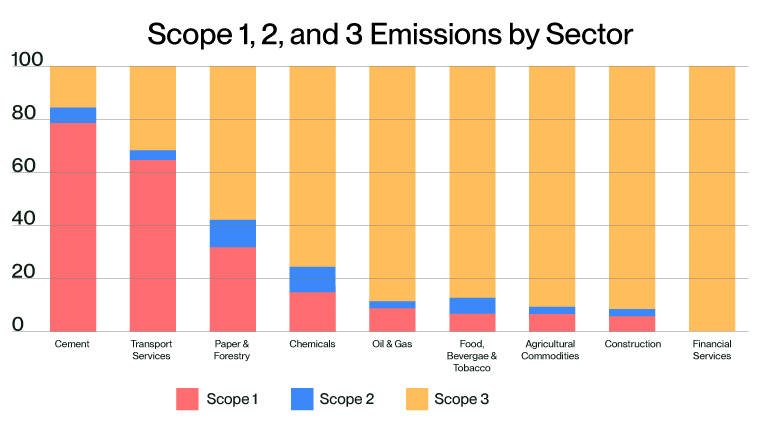
The arrival of the CSRD regulations ushers in a new era of transparency and accountability for organisational sustainability-related strategies and reporting. These regulations mandate granular emissions disclosure and the establishment of emission reduction targets across Scopes 1, 2, and 3.
The first set of CSRD standards, adopted by the ESRS on July 31, 2023, places an emphasis on the material impacts of organisations on people, the environment, and business / value chain operations. This includes environmental matters such as greenhouse gas emissions, energy efficiency, and associated dependencies. Social considerations are also highlighted, encompassing working conditions, human rights, and equal opportunities in the value chain.
What is the Difference Between CSRD and ESRS?
The second set of standards, to be adopted on June 30, 2024, aims to refine reporting by addressing levels and boundaries of reporting, emphasising the significance of Scope 3 emissions in measuring social and environmental impact. Ensuring you are ahead of these regulations on obtaining, monitoring and reporting on your CSRD Scope 3 emissions is therefore vital.
The CSRD’s Scope 3 requirements are set out in ESRS E1, the climate change standard within the European Sustainability Reporting Standards. ESRS E1 requires companies to disclose their gross Scope 3 emissions across all material categories, set targets for reduction, and explain how their value chain emissions relate to their overall climate transition plan. The first set of CSRD standards was adopted on 31 July 2023, with a second set addressing reporting levels and boundaries — including the significance of Scope 3 — following in 2024. Under double materiality, companies must assess both how climate risks affect the business financially and how the business itself impacts the climate through its value chain.
Everyone who has to comply with CSRD. The CSRD requires Scope 3 reporting, which includes the collection of sustainability information across a company’s value chain or supply chain.
Anthesis can support you to engage your suppliers and using our proprietary GHG inventory management tool to support the ongoing monitoring and reporting of your Scope 3 emissions.
A carbon footprint is the total amount of greenhouse gases (including carbon dioxide and methane) that are generated by our actions. Many organisations would normally consider a carbon footprint to only include Scope 1 & 2 emissions; however a comprehensive GHG inventory (i.e. carbon footprint), would also include Scope 3.
The TCFD recommends that companies disclose Scope 3 emissions where they form a significant portion (40% or more) of their overall GHG emissions.
Reporting other Scope 3 emissions is voluntary, but strongly encouraged where this is a material source of emissions.
No — Omnibus I did not remove or materially change the requirement to report Scope 3 emissions under the CSRD.
Yes — if a non‑EU company falls within CSRD scope, it must report Scope 3 emissions.
We are the world’s leading purpose driven, digitally enabled, science-based activator. And always welcome inquiries and partnerships to drive positive change together.


