Simpler Recycling
A guide for businesses and non-domestic premises to the Simpler Recycling requirements for England
On 31 March 2025, new ‘Simpler Recycling’ requirements came into force for workplaces in England with 10 or more employees as well as relevant non-domestic premises (including hospitals and nursing homes, educational establishments, and prisons). The changes are introduced primarily through amendments to the Environmental Protection Act 1990 as amended by the Environment Act 2021, and require the collection of food waste as well as a core set of recyclable materials, with paper and card segregated from other recyclables.
The measures are part of a wider reform of recycling collections being implemented by the government to streamline recycling collections and ensure households and workplaces in England recycle the same core set of materials. Local authorities are required to comply with household recycling collection requirements by 31 March 2026, and micro-businesses come into scope in 2027.
The government’s objectives for the policy are to:
The initial requirements launched on 31 March 2025 apply to all businesses and relevant non-domestic premises with 10 or more employees.
This employee number includes all employees, even if they are working out of different sites. For example, if a business has 16 full time employees, but only 8 working at each of 2 sites, the requirements still apply and each site would need to have separate recycling and food waste collection arrangements in place. Part-time employees should be included using a fraction based on their pro-rated hours. Volunteers do not need to be included within the total employee numbers.
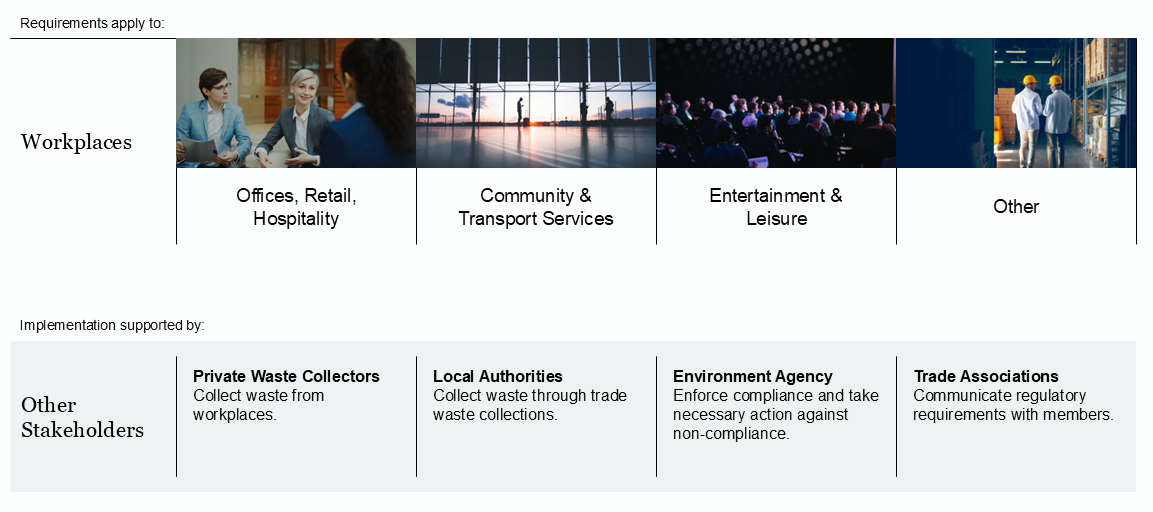
The requirements apply to businesses, charities, and public sector organisations that generate waste that is similar in nature and composition to household waste. This scope covers a wide range of sectors, including:
The lists above are not exhaustive. We recommend checking carefully to verify whether your business falls in scope. From 31 March 2027, businesses with fewer than 10 full-time equivalent employees (micro-firms) must also comply with the requirements. Franchises or chains should be guided by whether they are registered as separate businesses on Companies House when identifying their employee numbers and required date of compliance.
Businesses with 10 or more full time equivalent employees and relevant non-domestics are required to arrange collection of core recyclable waste streams: glass, metal, plastic, paper and card, and food.
Local authorities are required to collect the core recyclable waste streams from all households in England: glass, metal, plastic, paper and card, and food (unless a transitional arrangement applies; for example, long term waste disposal contracts are a barrier to collection of food waste).
Businesses with fewer than 10 full-time equivalent employees (micro-firms) are to arrange for recycling of core recyclable waste streams: glass, metal, plastic, paper and card, and food.
Collection of plastic film from businesses, relevant non-domestic premises, and households to be introduced.
Historically, there was no legal requirement for businesses to separate dry recycling or food from other waste. Simpler Recycling changed this, meaning businesses and relevant non-domestic premises need to present dry recycling and food separately to residual waste.
Paper is easily damaged and contaminated by other materials and is required to be collected separately unless the waste collector has completed a written assessment to set out why it is not technically, environmentally, or economically practicable for them to keep paper separate. An exemption to co-collect other dry recyclable materials has been granted which means collectors can collect glass, metal, and plastic packaging together, rather than separately, if they choose to without the need to complete an assessment.
In scope business should work with waste collector(s) to understand exactly how food waste and dry recycling is collected and treated to ensure the arrangements are compliant with the requirements.
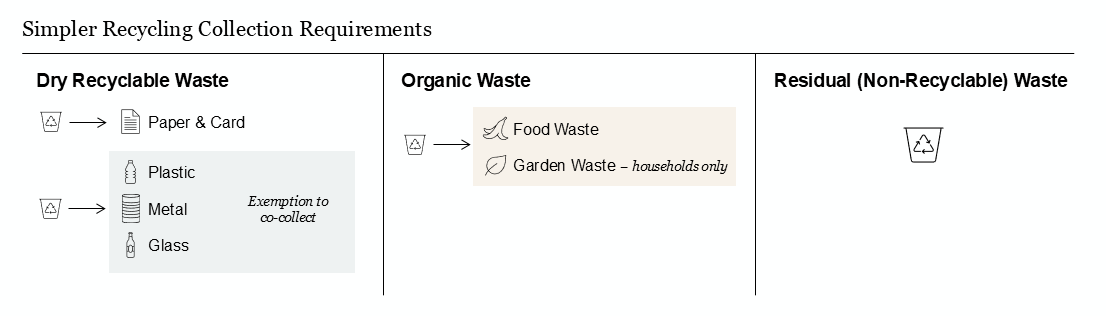
There is no minimum weight threshold within the regulations, meaning that businesses and workplaces that generate only small amounts of the in-scope materials must still arrange for them to be collected separately from residual waste. The in-scope materials are:
| Food Waste | All food intended for human or household pet consumption, including biodegradable material from the processing or preparation of food and drink, and inedible material such as bones, eggshells, and coffee grounds (noting this must be collected whether or not the site serves food or has a kitchen). |
| Glass | Glass packaging such as bottles and jars. |
| Metal | Steel and aluminium cans, aerosols, foil, food trays, jar and bottle lids, and tubes used as packaging. |
| Plastic | Plastic bottles, pots, tubs, trays, tubes, and fibre based composite cartons. From 2027, plastic film packaging and plastic bags must also be collected. |
| Paper and Card | Paper and card items and packaging such as office paper and paper and board packaging. |
| Garden Waste | If garden waste is generated by a business or workplace, it must be recycled or composted if it delivers the best environmental outcome. |
On-site composting of food waste is permitted as an alternative to food waste collection, but businesses choosing to do this must ensure that requirements for aerobic composting and composting material with animal content are met.
The new requirements are enforced by the Environment Agency. The government is encouraging reporting of sites that are not complying with the rules, and the Environment Agency’s role includes investigating these reports. It has previously stated that it will offer advice and guidance initially, but may then move to issuing a compliance notice. It is an offence to not comply with a compliance notice and further action may be undertaken according to the Environment Agency’s Enforcement and Sanctions Policy. The Environment Agency has stated it will use an hourly rate of £118 to cover its costs for taking action where businesses or non-domestic properties are not complying with requirements.
Enforcement action can be taken not only against businesses (i.e. the waste producer) but also landlords or facilities management companies that are presenting waste on behalf of the business.
The implementation of Simpler Recycling is providing a national overhaul of arrangements, presenting opportunities for businesses to get recycling arrangements right. Reducing waste and improving recycling arrangements can increase the efficiency of business operations, reduce costs, and improve customer and staff satisfaction.
The overall aim should be to minimise waste, divert more waste to recycling, and maximise the quality of recycling and food waste captured. Staff and customers should be supported to manage waste correctly.
An important first step is to undertake a waste assessment or audit to understand what types of waste are generated in different locations within your business, the recycling systems in place, and how well recycling systems are being used. This can provide insights into:
Once baseline performance is captured, you can take action to reduce waste and improve recycling. Setting goals to measure improvements against and outlining a clear waste policy, efficient procedures for activities that generate waste, and clear staff and customer communications are essential.
It is vital to use a waste contractor that has the right licenses to manage your waste. The Public Register of Waste Carriers, Brokers, and Dealers allows you to search for companies and check their registration details. Your collection provider should provide you with a waste transfer note, which you must keep (as either a paper or electronic copy) for 2 years.
We help our clients understand their waste impact and take practical steps to improve their performance. From analysing resource use and waste at each supply chain stage to implementing waste reduction initiatives, reuse, and recycling solutions, our services help make a real difference.
Our expert guidance includes:
We turn complex information into clear insights and strategic direction, providing tailored support to help our clients operate efficiently, meet environmental goals, and reduce their resource use.
Specialised commercial waste consulting services to support businesses in managing waste streams effectively and sustainably.
We are the world’s leading purpose driven, digitally enabled, science-based activator. And always welcome inquiries and partnerships to drive positive change together.
We’d love to hear from you