The S&P Corporate Sustainability Assessment (CSA) Score Guide
How to understand and improve your rating
1 March 2026

How to understand and improve your rating
1 March 2026

The S&P Corporate Sustainability Assessment (CSA) is an annual evaluation conducted by S&P Global that measures a company’s performance across environmental, social, and governance (ESG) criteria, measuring their management of material ESG risks, opportunities, and impacts. The resulting CSA score – expressed as a numeric score between 0 and 100 – reflects the company’s level of ESG maturity.
The assessment covers over 100 questions and dozens of criteria, from climate strategy and resource efficiency to labour practices, supply chain management, and corporate governance. Each criterion is weighted based on its financial materiality to the specific industry, meaning companies in different sectors are assessed differently
Results of the assessment are publicly available on S&P’s website, distributed to subscribers via S&P’s Capital IQ Pro platform, and are featured on Bloomberg’s ESG dashboard. Today, S&P’s CSA scores and ESG scores are used by investors, analysts, and sustainability teams worldwide as a benchmark for ESG performance. They are also used as criteria for inclusion in the Dow Jones Best-in-Class index series (formerly Dow Jones Sustainability Index family, “DJSI”) and the S&P Sustainability Yearbook, both external signals of competitive ESG performance. In fact, many in the industry still refer to the questionnaire itself as the DJSI, partly the result of the questionnaire having changed hands from RobecoSAM to S&P, while the index has remained the most relevant use of results.
Publicly listed companies can confirm their invitation status and eligibility for various indexes on the S&P website. Eligibility is based on company size within a specific geographic market. Please see the graphic below which presents the invited universe for each Dow Jones Best-in-Class regional index. The most recent constituent lists are available on the S&P website, and rebalancing occurs each April (beginning in 2026). Companies not covered by the research universe can also solicit the CSA as a Service and get a Public, Confidential or Provisional (based on hypothetical data) CSA and ESG Score.
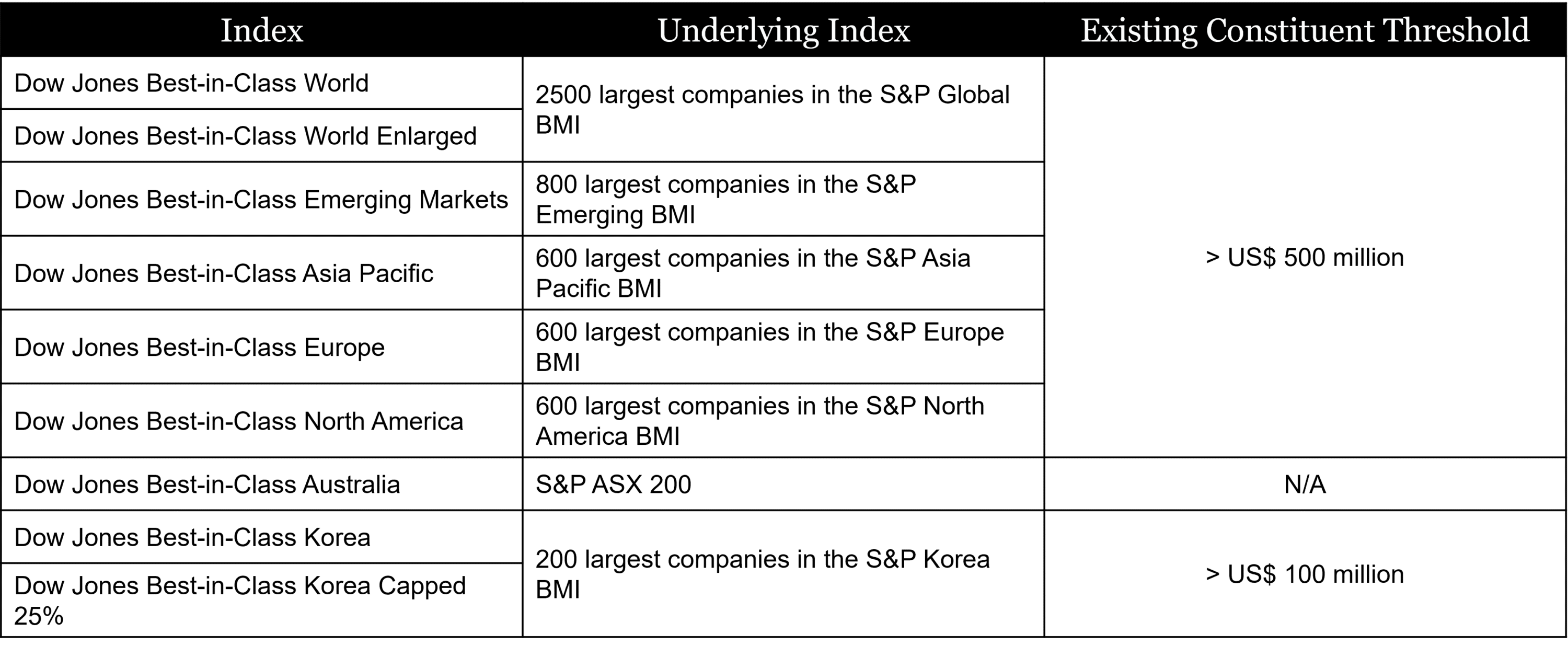
The Dow Jones Best-in-Class Index (formerly “DJSI”) and the S&P CSA are closely linked but serve different purposes. The CSA is the questionnaire companies complete each year. The DJSI is one outcome of the assessment – a financial index leveraging CSA scores that identifies ESG leaders in each sector.
To be considered for the Dow Jones index rebalancing, companies must submit their CSA response by the December 31st deadline. S&P then submits the final scores to Dow Jones based on the CSA results, and the updated index composition – including which companies are added or removed – is announced in April.
Not all companies with strong CSA scores will be included in the Dow Jones Best-in-Class index. Inclusion is competitive and sector-specific: only the top-performing companies within each industry make the cut. The number of eligible spots per sector varies based on index methodology and minimum score thresholds. Therefore, the score cutoff may vary widely between industries and across regional indexes. Companies targeting index inclusion should focus not just on improving their absolute score, but on understanding the competitive landscape within their specific industry classification. It is common for a company to target inclusion in their regional index, such as the North American Dow Jones Best-in-Class Index, but not the World Index, due to the competitiveness of the World Index. Conversely, some regional or country-level indexes, such as the Emerging Markets Index, tend to have higher score cutoffs than the World Index due to the wide adoption of the CSA and robust reporting practices in those regions.
Beginning in February, companies are asked to select a 2-month participation window, spanning from April through January.
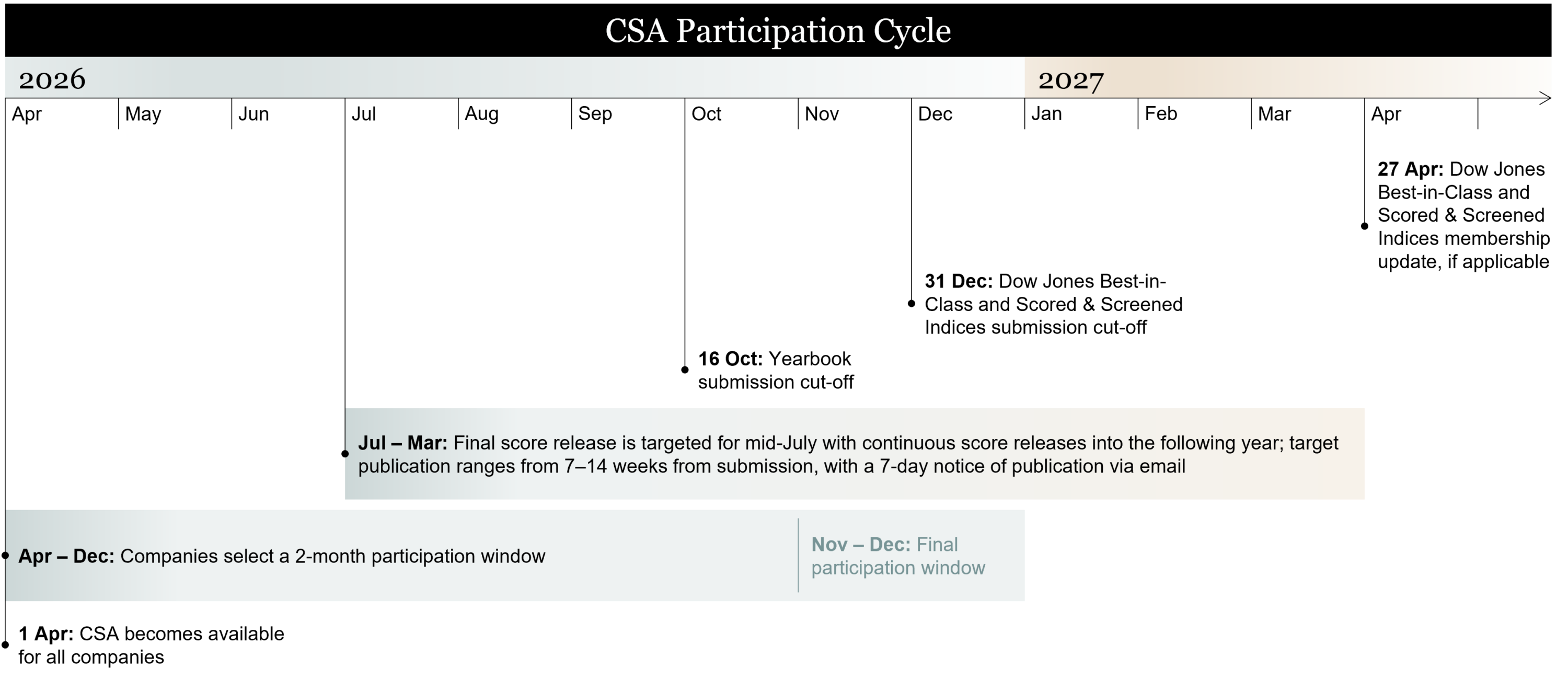
If looking to be eligible for the Sustainability Yearbook, companies should be sure to select a participation window with a submission date no later than October 16th. If looking to be eligible for Dow Jones Best-in-Class index inclusion, select a window with a submission date no later than December 31st. It is generally easy to request an extension through the CSA portal directly.
All companies who are part of S&P’s research universe will receive an S&P ESG Score, available publicly at the S&P website, which is based only on publicly available information. Companies do not need to directly participate in the CSA questionnaire to be eligible for Index inclusion or Yearbook membership.
However, it is highly recommended that companies participate actively in the questionnaire because:
Companies may actively participate in the CSA in one of two ways: Self-Paced and Review & Add.
The S&P CSA portal – accessed at spglobal.com – is the primary interface for submitting your CSA assessment, reviewing analyst revisions, and benchmarking your performance against industry peers. Understanding how to navigate the portal effectively is an important part of getting the most from your CSA score once it is released.
Within the portal, key areas to focus on under the “Frameworks” tab include:
Considered to be the broadest and most in-depth ESG rating product on the market, S&P’s questionnaire covers all facets of ESG, from cybersecurity to product stewardship to customer satisfaction and everything in between.
The questionnaire will open on the selected participation date, at which time you can choose to auto-populate the questionnaire with any content submitted in prior years. You will also need to select a data privacy option. Most companies choose NOT to share their data points and only share public information.
The questionnaire is structured by Dimensions, Criteria, and Questions.
Questionnaire example
The bulk of the questionnaire is the same across all companies, but a company’s industry will also determine the inclusion or exclusion of several questions, based on relevance. For example, all respondents to the CSA questionnaire will be asked core questions on Labor Practices, but an Automobile company will be asked questions regarding Warranty Provisions and Fuel Efficiency, while a Pharmaceutical company will be asked questions around Access to Healthcare and Ethical Marketing Practices.
The structure of each question can vary drastically depending on the type of information requested. You will likely need to source information from across your organization to address the questions, and it is important to ensure that the information referenced directly addresses the question being asked.
Anthesis experts can support your response process by organizing data collection and filling out the questionnaire with the most relevant information from your public information and any supplementally collected data or documentation.
Questions may be scored on any combination of the following factors:
In a questionnaire of over 100 questions and thousands of datapoints, it can be challenging to determine which gaps are most impactful for improving your company’s score. Anthesis experts can review your questionnaire for opportunities to improve your response and program to meet S&P CSA criteria.
The S&P CSA scoring process is based on responses to the annual S&P CSA questionnaire, which companies complete each year within their assigned submission window. S&P analysts then review all submitted responses and supporting evidence, making revisions where the submitted content does not meet the required standard.
Scores are calculated on a question-by-question basis, with each question contributing to a criterion score, which in turn feeds into a weighted dimension score. The final CSA score is a weighted average across all applicable dimensions for that industry. Weightings reflect the financial materiality of each topic to the sector in question – so a question around water stewardship may carry significantly more weight for a food and beverage company than for a financial services firm.
S&P shares two different score results for the CSA: a CSA Score and an ESG Score.
This allows end users of S&P data to compare “apples to apples” when comparing a company who actively participates in the CSA versus one that does not.
A company that actively participates in the CSA and provides nonpublic information regarding gender pay data, for example, will have a higher CSA Score than a company only scored based on public information that does not report anything on gender pay. However, these companies may have the same ESG Score. To model the ESG score, S&P makes a generalised estimate of a company’s ESG performance based on factors such as company size, industry, and geographic location. Both ESG Scores and CSA Scores are publicly available, but only CSA Scores determine Dow Jones index inclusion and Sustainability Yearbook composition.
Updates for the 2026 CSA are relatively minor compared to prior years. The most significant update to this year’s questionnaire is the addition of content pertaining to Responsible Artificial Intelligence, which many companies are just beginning to grapple with from a social responsibility lens.
Key 2026 Updates
For detailed industry-specific impacts, see the full analysis: 2026 Changes to S&P Corporate Sustainability Assessment.
We recommend taking the following steps to interpret and learn from your CSA results, helping you to improve your score in future years:
Supporting organisations to understand, disclose and communicate progress and metrics through our ESG reporting services.
In the CSA portal, on the Assessments tab, look for all questions with a black flag next to the question name; this represents a revision made by an S&P analyst. Opening up the question will allow you to toggle between your submitted answer and the revised version, which represents the accepted content used for scoring. It is normal for many questions to have revisions and it can be a powerful tool in understanding how to improve your CSA score for future years.
Review the revised content against your submitted evidence and the details provided in the “Additional information and question guidance” panel. The revision may represent an opportunity to improve disclosure next year, but in certain circumstances, it could represent an oversight by S&P that requires a direct inquiry. Some questions (Emerging Risks, for example) are often heavily revised; focus on the low hanging fruit that can be directly improved for future years.
S&P criteria reflect a very high level of ESG maturity and therefore can be leveraged to raise the bar on your organization’s policies, programs, and KPI tracking.
While the CSA process is still fresh in your memory, taking stock of where you lost points in your prior year’s score by conducting a gap analysis can be a powerful mechanism for strategizing future improvement opportunities. Review the questions where you did not score as well as expected, as well as new questions and those that have been changed significantly year-over-year. These questions pose opportunities to improve your disclosure and programs to meet more stringent scoring criteria.
One of the best ways to improve your S&P CSA score is by targeting specific datapoints and keywords for inclusion in your annual ESG reporting, as well as ensuring that all relevant policies are publicly available. Given the increase in oversight and auditing of ESG datapoints, starting the process of deciding which new content to include in your next reporting cycle early can help ensure you will be able to seek the necessary approvals to disclose content. If specific datapoints are not tracked yet, connect with the relevant content owner within your organization to discuss if and how that KPI might be tracked moving forward.
In light of new pressures such as mandatory reporting, strategic ESG planning is becoming business-critical.
For deeper gaps that cannot be closed with expanded disclosure alone, consider your organization’s strategic ESG planning. For example, if your organization is performing a double materiality assessment in the next year, look for opportunities to align outputs with requested information in the relevant S&P question. If developing a new commitment, review the relevant S&P criteria against it as one way to evaluate the strength of the policy.
After receiving your score, you can email [email protected] with three inquiries about your score.
We recommend doing this after an initial gap assessment and suggest that these three questions focus on opportunities to recoup lost points rather than general requests for more information. A consultant can help answer questions about your score, but only S&P can adjust your score directly.
Ideally, inquiries should:
Often, it is advantageous to have a third party review your assessment and identify improvement opportunities. Through supporting several organizations with disclosures such as the CSA, Anthesis has developed the expertise to help you understand and improve your score. Also consider whether S&P’s benchmarking tools may be useful in further evaluating your performance.
We recommend waiting until after December 31st, when the majority of companies’ scores are available, to publish scores and assess relative performance against peer companies. For added peace of mind until more scores are released, consider unticking the box that says “Include scores from previous assessment” on the Benchmarking tab of the CSA portal to ensure that all analysed scores are from the present reporting year.
The CSA score is the raw output of the Corporate Sustainability Assessment questionnaire. It reflects your company’s direct responses and submitted evidence, scored against S&P’s predefined criteria and weighted for your industry. It is the score that sits behind your percentile ranking in the CSA portal.
The S&P Global ESG Score is built on the CSA score but incorporates a degree of modelling. This modelling is designed to enable like-for-like comparisons between companies that actively participate in the CSA and those that do not. A company that actively submits non-public evidence on, say, gender pay equity, will have a higher CSA score than a non-participating peer that reports nothing on the topic – but their S&P ESG scores may be similar, because the modelling fills the gap.
The Dow Jones Best-In-Class index component selection process is not separate from the CSA – it is built entirely on it. Your S&P Global CSA Score, derived from your CSA response, is the sole basis for index eligibility and selection. There is no additional questionnaire or separate submission process for the index. Companies that submit their CSA response by the December 31st deadline will have their submitted questionnaire and resulting CSA score utilised for index selection. Companies that do not submit by December 31st will have a score submitted on their behalf based on public information only.
Selection is competitive and industry-specific. For the DJBIC World – the flagship global index – only the top 10% of companies within each of S&P’s industry classifications are included. Regional indices (DJBIC Europe, DJBIC North America, DJBIC Asia Pacific, etc.) apply a top 20% threshold, and country indices use top 30%. Importantly, there is no roll-up between indices: inclusion in a regional index does not automatically confer World index membership.
Yes – S&P publishes CSA scores publicly. You can look up any company’s S&P Global CSA and ESG Scores on the S&P Global website without a portal login. More detailed benchmarking data, including peer comparisons and historical trends, is available within the CSA portal for invited companies and via S&P Capital IQ Pro and Bloomberg for subscribers. Your own CSA portal also includes a benchmarking view showing how your score compares against your industry peers, though bear in mind the mixed-year caveats noted above.
There is no standard submission timeline for the CSA, but companies who are aiming for external recognition via the Sustainability Yearbook or Dow Jones Best-In-Class index should submit by the mid-October or December 31st deadlines, respectively. S&P opens the assessment window in April, giving companies the option to select from several 2-month submission windows. Companies can select their own submission window within this period, which determines when their score will be released. Earlier submission windows receive scores earlier, in rolling waves from July onwards. However, selecting an earlier window may give companies less time to prepare their responses or add new content to public disclosure to address new criteria.
This is one of the most common points of confusion in the CSA process. Because S&P releases scores in rolling waves throughout the year rather than all at once, your percentile rank is calculated against a moving population. When your score is first released, S&P uses a mix of current-year and prior-year scores for companies that haven’t yet received their updated result. As more current-year scores come in, the benchmarking population shifts – and your percentile rank can move, sometimes significantly, without your absolute score changing at all.
For this reason, we recommend waiting until after December 31st, when the majority of current-year scores are available, before drawing conclusions from percentile comparisons or publishing your ranking externally.
The CSA is separate from mandatory reporting frameworks like CSRD and GRI, but there is significant overlap in the underlying data and disclosure requirements. Strong CDP reporting, for example, directly benefits CSA performance on climate-related questions. By publishing your CDP response publicly, for example, you can leverage the entirety of the response as evidence for relevant sections of the CSA questionnaire. CSRD’s double materiality assessment outputs can also be aligned with CSA materiality questions. GRI-aligned sustainability reports often contain the public evidence S&P analysts look for when scoring disclosure-dependent questions.
Rather than treating the CSA as a standalone exercise, the most efficient approach is to build a single ESG disclosure programme that simultaneously meets CSA criteria, CSRD requirements, and CDP reporting needs – identifying the overlapping data points and ensuring they are publicly evidenced in your annual reporting. This is particularly important given S&P’s consistent tightening of public disclosure requirements year-on-year.
Anthesis has supported companies across multiple industries through the CSA process – from first-time participants to organisations targeting Dow Jones Best-in-Class index inclusion. We provide:
We are the world’s leading purpose driven, digitally enabled, science-based activator. And always welcome inquiries and partnerships to drive positive change together.