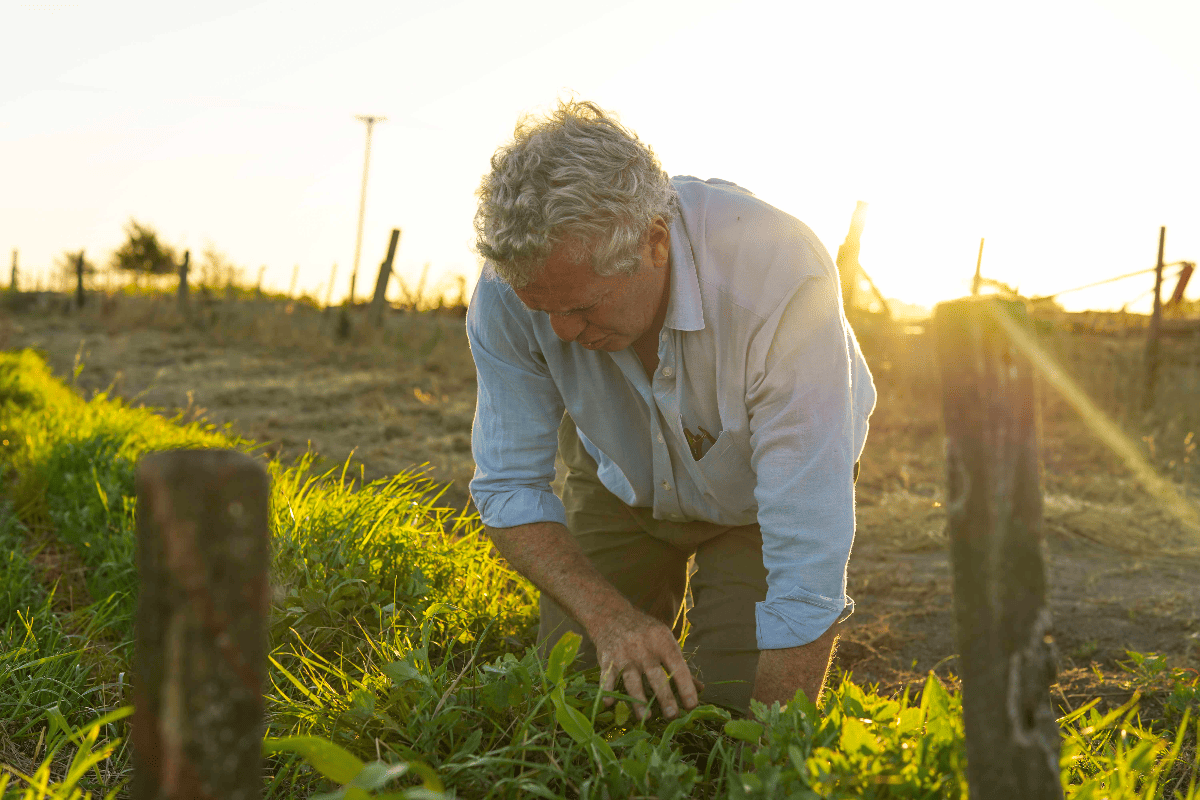
ReTerra: Scaling Regenerative Agriculture Across Brazil
Activating Sustainability | 27 January 2026 | Ep. 63
Roberto Strumpf: – Carbon Business Development Senior Manager, Rabobank Brazil
Pablo Francisco Borelli – CEO, Ruuts
John Leppers – Managing Director, Anthesis Netherlands
Chris Peterson – Director, Anthesis North America
In this episode of Activating Sustainability, host Chris Peterson is joined by Roberto Strumpf (Rabobank), Pablo Francisco Borrelli (Ruuts), and John Leppers (Anthesis Netherlands) to explore ReTerra, a pioneering regenerative agriculture and soil carbon initiative in Brazil. Together, they unpack how financial institutions, technical experts, and farmers are collaborating to restore degraded land, strengthen food security, and unlock long-term climate and resilience benefits through regenerative land management and carbon finance.












Chris Peterson: Hello and welcome to Activating Sustainability, the Anthesis podcast. I’m your host, Chris Peterson. I’m excited for today’s episode as we explore the world of regenerative agriculture and how Rabobank, Ruuts and Anthesis came together to develop a new project called ReTerra. I’m pleased to be joined by three individuals at the heart of the effort: Roberto Strumpf who leads the Carbon Bank Brazil for Rabobank. Pablo Francisco Borelli, CEO of Ruuts, and John Lepers, managing director of Antithesis Netherlands. Welcome to the podcast
Pablo Francisco Borrelli: Thank you, Chris.
Roberto Strumpf: Thank you for having me, Chris. Pleasure.
John Leppers: Great pleasure to be here with you again, Chris.
Chris Peterson: This is such an exciting project and really fascinating, so I’d be curious, maybe just start at the beginning, where did this start from? Where was the inception point? And I know from previous conversations it sounded like Roberto, it was some of the things you were seeing from your clients within Rabobank and the farming community.
Roberto Strumpf: Starting from the beginning, I think it all started from the realisation in Rabobank that we have a huge challenge ahead in this century, which is to bind food security, environmental protection, and also a realisation that Rabobank can play a very important role as a bank that works in the food and agri sector around the world.
So, from that, Rabobank decided to establish a land use strategy where one of the main pillars is to reduce or reach zero degraded land in our portfolio. So, this is something that has been driving strategy in the bank for a few years, and one of the reasons why the bank came up with Carbon Bank, which is the programme to help our clients navigate in this new carbon market.
So, from that, we started, looking for potential partners in the sector and happily enough came up with Anthesis and Ruuts to help us bring the knowledge, the support, to work closely with our main clients in Brazil.
I’m speaking from Carbon Bank, Brazil. The programme landed about two years ago. This was my responsibility to bring this initiative, and the region here is a priority for the bank for I believe obvious reasons is one of the main agricultural producers and also a huge, region in terms of natural capital.
So that’s, I think in a nutshell, the beginning of all.
Chris Peterson: Fantastic. Yeah, and there are a number of pieces I’m keen to come back to within that. I know Pablo, this wasn’t the first project that Ruuts has done around regenerative agriculture or supporting farmers. So curious, how did you end up getting involved in, ReTerra.
Pablo Francisco Borrelli: So it, it all started like 20 years ago. We pioneered the introduction of regenerative grazing in South America. This was my father. So we’ve been working for many years in how to help farmers in this transition. How to make decisions, a different way, trying to mimic nature and to gain productivity at the same time that you can restore and regenerate an ecosystem.
That was a long learning process, and we ended up developing carbon programmes to scale all these processes and to bring new incentives for farmers to change. In that work, we started working with Anthesis, three years ago in another programme called SARA where we are getting farmers from Paraguay, Argentina, and Chile, into this transition and generating carbon credits.
After that, we started working on this, ReTerra project in Brazil. But what is our mission and purpose here is to make a change among farmers to make regenerative agriculture mainstream in Latin America, and very focused on the farmer process and what they need to understand and how they need to work in order to start making things differently.
And another big component is the monitoring of all this. How do you monitor if a farm is actually regenerating? And if it’s actually capturing carbon. And that’s an elemental process for all this, not only for carbon credits, but to understand what’s happening at the farm level and if decisions are being on the right direction.
So this is what we are bringing in the table and I’m very enthusiastic of Brazil and the opportunity because agricultural land is massive and there’s a lot of work to do.
Chris Peterson: Fantastic. And then maybe, John, do you want to talk a little bit about why and thesis and how we all became involved?
John Leppers: We’re working on the great transitions of the world. How do we sort of move away from an old economic model to a newer economic model? And one of the things of course is, are we able to change the food systems of the world and what can we also do to increase soil health? Again, there’s much degraded land around the world, and what can we do? And that from an Anthesis perspective is the lens which we also look at, opportunities and projects.
If you want to have a transition, one thing that we understand very well, is change is not easy. Yeah? To bring about change. You need to get things moving, but also you need to incentivise people over a much longer period of time. You can’t do it by yourself. So you need to work in partnerships with many groups. And that’s something that we do well and organise.
Particularly in ReTerra our role, if we make it small, it’s around putting the money into the mechanism to enable the change, and we do that through carbon finance. The role that anthesis plays is to get projects registered and actually through the global registries get carbon credits issued and sold. That’s the part, but much more importantly, and carbon is the bit that the world has put a value to from a carbon credit perspective. So a financial value to. But if you look at this project, it also hits on regenerating farmland, it actually supports farmers with, changing their levels of income to also support them in the, in the transition. But what it also does is for this project to be successful, you need to be thinking multiple decades. So this is not a fast change, this is a change that’s also has a long-lasting impact. And that’s the bit that we do. And when Rabobank said, ‘Hey, gosh, we’ve got an idea’, and Ruuts said we can do something, we came in and joined it with the finance part to make it all happen.
Chris Peterson: Fantastic. Yeah, and it clearly the overlap of the vision that you all have and the ambition that I’m hearing. That kind of, really changing the way farmers operate across Latin America is a really inspirational piece, and hearing the contribution around the zero degraded land in your portfolio within Rabobank is just so inspiring.
So I’m curious, kind of maybe taking it to the next level of ReTerra itself, Pablo, do you want to walk us through what is it and how does it contribute to those goals and visions?
Pablo Francisco Borrelli: The project it’s aiming to bring improvements to the management of the farmers to regenerate land. At first glance, we are working with very sophisticated farmers the Rabobank clients, so many of the
typical region ag practices, they were already being done like no till. Like in many places, this can be additional to a carbon programme. So here, the first thing was, okay what can we improve to this management to actually, be able to increase the carbon stocks and to improve the soil health? So we ended in the integration of livestock and crop systems in an improved way that is traditionally done.
It’s bringing cattle back to the land and to improve the health of that land and to generate carbon credit out of that. So this is the main change in the management that we are promoting, and also working on the, just grazing lands in the improvements of the rotations that the farmers are doing.
So this brings. Two big benefits for the farmer. One is, of course, participating in a carbon market and, with the carbon credits, but the other one is they can decrease the amount of inputs that they need to produce, the crops. So that’s another benefit that is bringing, and it’s creating a much more resilient system because it depends less from inputs.
So it, it makes. A really big change in, their business, asset is also an important piece of the programme.
Chris Peterson: That’s fantastic. And maybe Roberto, just thinking about your comment about really trying to move the farmers and the resiliency of agriculture, we would love to hear from you, how does this fit into your vision and practice?
Roberto Strumpf: The vision, as I mentioned, is to produce as much as possible per hectare. This is important because the population in the world, we are going to reach about 10 billion maybe in the mid-century. Yes? We have been feeding this increase in population with increasing productivity, with the green Revolution from last century.
However, in the cost of a lot of chemical inputs and a lot of land as well. Especially in a place like Brazil where deforestation is an issue. So the vision of the bank is we want to produce more per land with less inputs, less chemical inputs, as Pablo said, learning, with the lessons from nature, which is to regen the natural fertility of the soil. So there many benefits from that just financial, social, and biological benefits.
And as a huge co benefit of the programme, reduce the pressure to open new land. And this is key to Rabobank, and this is the vision because by doing so, we will tackle the other big pillar of lend use strategy, which is to reach net zero deforestation.
It’s a huge ambition from the bank. It’s something that we are very looking for and working in. So it’s one programme with so many potential benefits to us, to our clients, and I guess this is why we are so excited about it with the first steps still, only few clients already engaged, but we are looking to make it very big, scale it very fast.
Chris Peterson: I picked up quickly. You all have very large ambitions for this and understand where that’s coming from, which is really exciting because I think that’s what we need to drive the level of change we need.
John, you know, often when we hear about kind of cattle and livestock in Brazil from a carbon perspective, that’s got a very negative view. How does ReTerra show up in terms of climate impact and reducing impacts around that?
John Leppers: Is cattle good or bad? It has a certain lens in life and also very much depends on which region you are. Again, I’m from the Netherlands, and if you then think about cows and cattle on a very high intense basis that is, somewhat at odds with a sustainable sort of regenerating world that we want.
There’s many other places where there’s a very healthy interaction between cattle and agricultural management because you need cattle and what they process in order to actually aid the regeneration of the soil. Doing it without cattle is actually more difficult, if not possible, in some extent. But it’s it’s always a question of how much and how far.
The fun thing is if you start to see cattle in a model of former sort of herds of wild animals and how they actually support an ecosystem, and that’s partially also what Ruuts is mirroring. Then all of a sudden, the interaction between animals and nature can be very positive. Where the big question is coming into is how much cattle can you sustain and when you take it over a certain level. And that is also why it’s so important to bring agricultural produce and cattle management in sync with one another. At that moment in time, it’s also not necessarily competing with like, Roberta says, with keeping the Amazon there. Because you need more land to feed more cattle because then it becomes a highly inefficient system from a natural perspective. But if you have them in a more symbiotic way, you can actually have many positive benefits coming from that. And so that’s how we look at it.
One of the things that regen ag programmes do and need to do, you also need to look at the natural habitat in which it exists. Because not every intervention will work in exactly the same way where you are. And that’s also what we find exciting to make it work for Brazil
There have been times where people ask me, but John, what is different to what you do, to what other people do? And the bit that really stands out for me is we are outcome-driven. And that sounds quite odd ’cause a lot of the region ag activities are do this, do that, and then it shall be better. But we’re really looking at making it better. And the one analogy I have for myself is if you need to perform as an athlete, you can either perform well because you are fit or because you’re taking painkillers at the time, or high sugar intake, or whatever else that allows you to act at your peak performance. But it doesn’t mean you are fit, it just means you can perform for a specific moment in time. But you are using too many of your resources, and you can only do it for a relatively short time.
And that’s actually what a lot of agricultural systems are doing. They’re just depleting soil health too quickly. If you want to get fit as an outcome, you really need to rethink. It’s not around how do I optimise the performance of the day, but how do I optimise performance capability over a longer period of time? And that’s the fundamental shift. You know, getting fit is something else than doing well on a given day. And that’s really what we’re trying to do with these programmes.
Chris Peterson: That’s a great transition, John. I’d love to hear from you all. How does that work in practice? What is different around this? And Pablo, it sounds like this has been a generational effort that you’ve been pursuing through your family. I’m curious what drives that kind of shift in practice?
Pablo Francisco Borrelli: Basically, we work, as I said before at, the decision-making level of the farm runs or the farm operators. And it has to do with mimicking nature in a sense of planning the grazing events to give enough time to those plants to recover from every grazing event.
So normally what you find, is either continuous grazing so the animals are for too long in the same paddocks. So, they eat the plants too much, they are not allowed to recover after the grazing event. Or many times they move too fast, it’s like very fast rotational systems that they also do not allow the plants to completely recover. So one of the elemental things is working with the pharmacy in a planning procedure in how to do those movements in order to allow the grassland to completely recover.
And on the crop side is working in this integration with the animals and bringing perennial pastures in the middle of the seasons, and to try to keep those perennial with the grazing as long as possible to increase the amount of organic matter of that cropland. In that way, as we recover the health of the land, we can decrease the amount of inputs used for crops.
So those two are the biggest elements in this programme. But I think what’s most interesting is. It’s not a prescribed recipe. It’s working with how they are making decisions, and that’s permanent and permanent change and again, very important is the monitoring as, John said, the outcome-based.
So every year we’re going to check, we have different indicators, how we are doing with soil erosion, how we’re doing with infiltration. So we’re going to look all this and we say, okay. What we are planning with this farm is working or we need to change things, and that’s a continuous learning process. It never ends.
The interesting element we’re bringing is change and an evolution, a constant evolution of, how we make decisions to have the farm all the time improving.
Chris Peterson: That’s great. And Roberto I feel like you, and maybe this is wrong, but seem to be living in two worlds of living within Rabobank and kind of that banking culture, as well as trying to think about this kind of really long-term investment approach to how do we support farmers moving forward.
So curious as you think about those needs and making that choice of ReTerra being the appropriate path to really go and pursue. What kind of drove that and what do you see as unique about this approach versus some of the others that I imagine you evaluated or considered?
Roberto Strumpf: The feats and the complementaries I see with the work of Anthesis and Ruuts are huge because I feel like the main, responsibility of RaboBank in this puzzle is to deal with two main pieces, very important ones, which is the human factor and the finance factor.
The human factor is leveraging the long-term relationship we have with the farmers to try to make them understand and work with them, to customise these, new productive systems coming from Ruuts’ technical crew, and how this can shift into the reality of these farms that are very sophisticated, very big, and convince them that this is the best path forward.
It’s not something simple. I believe this is something that have been taking a good proportion of my time in this last few months.
And the second piece, as I mentioned, is the finance. So this is a project where there’s a lot of investment up upfront, in time, in boots on the ground, traveling around with the farmers planning, implementing the practices to have the returns.
For the farmer the returns will come in one, two years. For ReTerra it depends on the carbon credits, which takes maybe five years to be really liquid and coming as revenues to the group. So I believe Rabobank plays an important role in closing this financial gap, helping finance our partners and also our clients.
Regarding our clients, we do have very specific financial products that we are offering that has a green component, that has a transition component and where the bank is happy to give discounts, to be able to do this transition that we feel like is fundamental for the world, for our clients and for the bank.
The resilience of our clients is the resiliency of the bank at the end. So it’s just a matter of having a bit of a longer-term vision to the finance system, which something that I think is lacking. And I’m happy to say that I feel like how bank has this.
John Leppers: I have to smile a little bit. When Roberto said it, because one of the challenges that we’ve had is an institution like the Rabobank, are they really capable of making decisions on a programme that has a duration of 40 years? ‘Cause that’s what a carbon programme is and does. And I think that’s a compliment to the Rabobank and the Rabobank leadership because as a minimum, they’ve convinced Pablo and myself that were in it for the long haul, so well done. But I think from a corporate perspective, you start to see that the planning horizons on these transitions really also start to come in at board levels and their willingness to enter into this, and that is no longer on a procurement basis, are we able to get everything down in contract to the ultimate detail, but much more like this is a partnership and we know we don’t know everything on this duration, but we’re all committed to make it work.
And that’s a very big compliment because that is to some extent financial institutions are often seen as wanting to de-risk, and I think, while still this is actually de-risking from a long-term transitional perspective, making sure that their farmers as clients are healthy, but at the same time, within their business model, this is much, much longer term thinking than a lot of other decisions that are being made. So I find this also very encouraging to see an institution like the Rabobank taking this step. This is really a huge leap forward and a big compliment to them.
Chris Peterson: Absolutely. And maybe just building off of that, Pablo had mentioned about the monitoring piece and building that credibility over the long term. I’m curious, John, kind of how do you see that credibility being built up in terms of faith and, you know, capital behind the kind of long-term benefits that we’re anticipating
John Leppers: There’s a couple of big things. What’s building some credibility is this is the third programme that Anthesis is involved in the first, we actually started in South Africa, a regenerative agricultural process that actually has already issued credits. And we’ve also been able to get to have finance flow back to farmers, and we’re now into the second issue in cycle of that programme. And we’re very close to reaching issuance on SARA, which is our second programme, ReTerra then being our third. And that’s also building credibility as a party in this space that we’re not only all about talk, but we’re actually about doing it. And quite innovative because there’s only 13 programmes worldwide that have achieved a formal state out of which two Anthesis is involved in, and only five have achieved issuance, of which Anthesis is one. So that’s one way of achieving credibility.
Second, is that carbon sequestration in soils. We need to reduce emissions very quickly. We need to take CO2 out of the air and somehow store it for a longer period of time. And we need to have transitions because people still need to eat live and the economy also needs to run. This is not in competition with anything else. Yeah. So this actually provides food to a growing population whilst also regenerating soil, whilst also sequestering carbon for a longer period of time. So when you think about in the sweet spot of the transitions that we need to have, and some of the pressures that are coming. This also is in the long-term trend that is required, and you start to see it come into legislation. For example, Europe has just passed new legislation in which soil, carbon credits, or soil carbon sequestration is a big portion of the future. You see it in other places as well. Capturing carbon will become critical. And that also gives long-term credibility that we’re on the right track with these types of interventions. \
So we believe by bringing short-term credibility, we can actually do this thing to farmers and give money into the mix to make those transitions happen. Also, with the long-term transitions and also where you see the world trending, we believe we’ve got credibility on that. And with the three parties in the podcast today, it’s not because we’ve just come new to this. The Rabobank has been banking for a fair while in the agricultural sector, Ruuts, has been doing this for 20 plus years, so they know what they talk about. And also Anthesis has been in the carbon markets for more than 20 years. So these are not newbies, gold diggers. This is actually a many centuries worth of experience coming together to make it happen.
So that’s hopefully slightly longer answer maybe than you were looking for, but this is why we believe we, we’ve got credibility in this.
Chris Peterson: Absolutely. Yeah. No, and I think the detail’s important, right? Because I think that’s always the challenge. So I recognise we’re coming up on time and I thought maybe what we could do is I would love to hear how is this impacting the various stakeholders?
And maybe Pablo, having you speak to some of the experience with the farmers or a farmer that has really jumped out for you. Roberto would love to hear kind of how that engagement went internally. Within Rabobank and kind of what clicked within that. And then John would love to hear from a client perspective, how are they viewing this as the credit they’re looking to buy as opposed to necessarily kind of just a cheapest commodity credit they can grab within that. But maybe Pablo, do you want to start us off?
Pablo Francisco Borrelli: Yeah, the good thing about this project is the farmers are doing the first pilot to see what happens. So it’s not that they’re putting all their land into the management shift. We are testing and we have to prove that this is better.
So they are having a look. They are not ‘all in,’ they are ‘okay, show me that this works.’ So this is the stage we are in. We are signing the first contracts. Now we have to show that this works. So engaging with the operational teams to make sure that the implementation is well done, that we are monitoring correctly, that we adjust if we need to adjust, but we are creating the first success cases that we will build all the programme on top. We are working with the early adopters. The ones that are like, okay, I think there’s something interesting here, and they’re stepping in, so we have to take care of these farmers and make sure that this, that they can see results in the short term. And very happy to see this kind of farmers engaged. They’re very large farmers, so, the opportunity is massive because they manage a lot of land. This is a little bit what we are seeing at the farm level.
Roberto Strumpf: I’m going to talk again about the human factor because I always think it’s, one of the biggest challenges. I’m very optimistic. I believe that in Brazil and the world is understanding finally that agriculture can be a solution. Now, talking internally as John said, Rabobank is a 126 years old company and 36 years in Brazil. And this carbon journey arrived about two years ago, so it’s very new. But we are having a lot of interest coming from our relationship managers in the branches that has this sometimes 10 to 15 years relationship with farmers. And had never heard about carbon in the soil becoming a financial asset, right?
We are starting this education process or positive contamination internally. And actually next year, what we are going to do is to do a road show in our 17 branches in Brazil. Bringing this content and exploring how to couple the carbon credit with the financial products we have for years now and make this one package.
And what the returns we are having from the senior leadership is very positive and opening doors internally in the company for us to do this process. And finally, our farmers or our clients, many of them have family business, for generations doing the same thing, doing very well. However, sometimes depleting the biggest asset they have, which is the natural fertility on the ground. And we have now seven clients engaged. Very willing to continue with us in this forties journey and many others knocking on our doors as the message starts to build. So again, just a message of, positively and optimist about the future of ReTerra
John Leppers: From a client’s perspective, an awful lot of sectors are dependent on the Agri-Food agricultural sectors for their own business models. And whenever we talk about how do you take accountability for your remaining emissions, you see a desire to do it in or close to their supply chains. And so that’s a sector that is very willing and interested to do so, and you’ll be surprised where all of the produce is going when you talk about milk or cattle, it goes in many, many ways and directions. And that’s sort of where we get a real, good response from clients and particularly, and that’s an important element, they recognise that farmers are often at the end of change and they’re really on the ground. And some people then call it Scope 3. Which doesn’t really sound very exciting, but as a farmer at the end of it, working with animals on land and these programmes really address at that level. And so we are away from policy. We’re away from big things, we’re away from technicals back into land, people and animals, and I think that gives a closeness to what we’re trying to achieve. That is really exciting.
And that’s also the story are, we are promoting and I would encourage people, if this is exciting to you, there’s lots of materials out there, videos out there on farmers talking, what it did for them. And that is also the bit that every day excites me. We’re talking about real on the ground change, boots on the ground.
I’ve been out on the field for a number of times. It’s really exciting to see, and that’s also what clients feel. They feel they are. Investing in the transition, and that’s just great to see.
Chris Peterson: Fantastic. Maybe just one last question. We’d love to hear from each of you, 40 years from now, what do you hope to see coming out of what is it you all have initiated here with ReTerra.
Pablo Francisco Borrelli: Yeah, I see ReTerra as a vehicle to make a significant change in the Brazilian agriculture sector. So, I would like 40 years from now that what we are proposing is the new norm, like common practice. And also improving what we are doing now. Like there’s a lot of things that we can, also bring as next levels for ReTerra, we are discussing trees. There’s a lot of stuff that can happen in those biomes to regenerate. So we are just starting, so I, think, we have a huge opportunity in really driving real change at a large scale in, in Brazil.
Chris Peterson: Fantastic. Roberto?
Roberto Strumpf: There has been a major role in disconnecting food security and food productivity from land conversion in Brazil. This is one thing. And the second thing is numbers vary a little bit, but it’s safe to say that we have now in, in Brazil about 90 million hectares of degraded land.
And my vision for 40 years from now is that we can have a completely different scenario, where every hectare of this is restored, producing food and having, biodiversity in the soil, that gives also a lot of resiliency to our farmers because in 40 years we will be facing more climate change than now, unfortunately, part of the problem will happen, so we will have more productivity and also more resiliency in the field.
Yeah, that’s my vision.
Chris Peterson: Fantastic, John, those are hard to follow up, but I will put you on the spot.
John Leppers: I’m showing my age, and I never know what’s a good analogy, but Hannibal always said at the end of each episode, ‘I love it when a plan comes together’ because in all honesty, how is this going to work? We don’t know. But in 40 years’ time, I really hope to be able to say that, and it is possible to regenerate land, increase production. Get some money for doing the right things, and passing it on to the next generation better than we got it. Wow, if I can have four ends in one sentence, I really love this plan to have come together. That’s what I hope to say in 40 years time.
Chris Peterson: Amazing. Well, thank you all so much for sharing insights and your perspectives and the stories. I really appreciate it.
And thank you all for listening. Please be sure to check out the resources linked in the show notes and on the Anthesis website at anthesisgroup.com. Thanks again and take care.
If you have any feedback on the podcast, get in touch with our main host Chris Peterson at: [email protected]