Hidden Costs: Why NGER and ASRS Disclosures Deserve the Same Rigour as Financial Reporting
20 July 2026

20 July 2026
Climate and emissions disclosures now carry sustained regulatory scrutiny, meaning the cost of inaccurate reporting is only going to grow. For many businesses, the direct cost of preparing emissions reporting under the National Greenhouse and Energy Reporting (NGER) scheme and Australian Sustainability Reporting Standards (ASRS) disclosures is only part of the picture. The larger financial and operational burden can emerge when reporting errors trigger rework, audits, remediation activities, additional assurance requirements and, in some cases, regulatory enforcement action – not to mention the risk of reputational damage.
Recent activity from both the Clean Energy Regulator (CER) and the Australian Securities and Investments Commission (ASIC) provides insight into the level of diligence regulators expect organisations to demonstrate when reporting emissions and climate-related information.
An Executive Officer of a company remains accountable for the accuracy of submitted NGER reports. The CER has historically required inaccurate reports to be corrected and resubmitted, creating additional cost and internal effort. However, recent compliance activity indicates a growing focus on reporting quality and governance processes.
In its 2025–26 compliance priorities, the CER stated that repeated inaccuracies or failures to report on time will trigger compliance or enforcement action, and that details of late reporters will be published.
Similarly, in its January to March 2026 compliance update, the CER noted that it had completed assessments of 2024–25 NGER reports, focusing on reporters with a history of reporting errors and safeguard facilities eligible for Safeguard Mechanism Credits. As a result, eight NGER reporters were nominated for audits, including five safeguard facilities. The regulator also stated that reporters failing to meet their obligations should expect enforcement action, including infringement notices and penalties.
In some circumstances, organisations may be required to fund regulator-directed compliance audits. Beyond the direct audit costs, these activities often require significant management time, data reviews and governance oversight.
The implications can extend further where reporting weaknesses result in enforceable undertakings. These arrangements are publicly disclosed and typically require organisations to implement extensive remediation programs, often involving additional governance, assurance and legal oversight.
The CER’s enforceable undertaking with a large oil and gas company provides a useful example. Among other commitments, the organisation undertook to develop and implement a comprehensive documented system of controls to support NGER reporting decisions, establish an internal assurance methodology and conduct annual reviews of control effectiveness over a three-year period.
Viewed through this lens, the cost of a reporting error extends well beyond correcting a dataset. It can trigger years of additional governance, assurance and compliance activity.
While climate-related financial disclosures under ASRS AASB S2 are in the early stages, the direction of travel is clear.
ASRS disclosures form part of a statutory Sustainability Report under the Corporations Act and sit alongside director declarations and assurance requirements. Both directors and senior officers may face personal liability in relation to reporting obligations, in addition to obligations placed on the reporting entity itself.
ASIC has stated that it intends to adopt a pragmatic and proportionate approach as organisations implement the new requirements. At the same time, it has consistently communicated that climate disclosures should be treated with the same discipline and rigour as traditional financial reporting.
Importantly, ASIC and the CER share similar regulatory postures. Both regulators apply risk-based approaches to supervision and enforcement, and both place significant emphasis on organisations having effective systems, controls and governance arrangements in place. The existence of a Memorandum of Understanding between the two regulators further reinforces the importance of reporting quality across both regimes.
For boards and executives, this means emissions and climate-related disclosures should be viewed through the same governance lens as financial disclosures.
A common theme emerges across recent regulatory guidance and enforcement activity.
Regulators are not only focused on reported outcomes. They are increasingly interested in the systems, controls, governance arrangements and decision-making processes that sit behind those disclosures.
The organisations that place themselves in the strongest position are able to demonstrate:
In practice, the ability to demonstrate due diligence can be just as important as the reported numbers themselves.
Against this backdrop, there is a strong case for managing NGER and ASRS reporting through a single integrated framework of processes, governance and accountability.
While there are important differences between the two regimes, NGER data provides the foundation for much of the Scope 1 and Scope 2 information required under ASRS. A significant proportion of reporting activities, controls and governance processes therefore overlap.
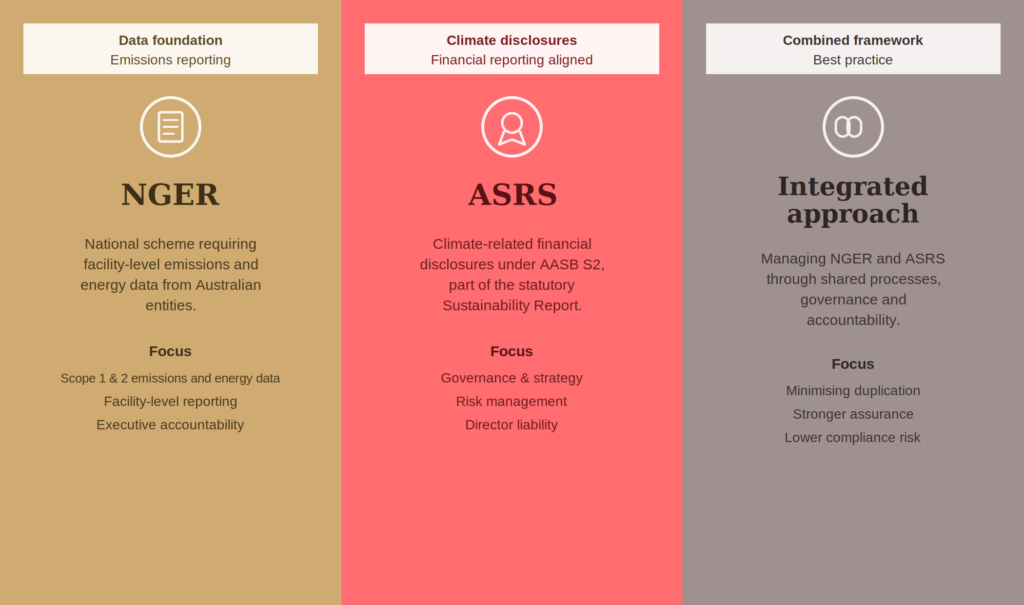
An integrated approach can help reduce duplication, improve consistency of reporting methodologies and simplify assurance and review processes. It can also provide greater resilience where key personnel are unavailable during critical reporting periods.
For organisations using external advisers, integrated reporting arrangements can further reduce inefficiencies associated with multiple methodologies, duplicated data requests and disconnected governance processes.
The most significant cost associated with NGER and ASRS reporting is often not the reporting process itself. It arises when weaknesses in governance, controls or reporting systems are identified after disclosures have been submitted.
Recent action by the CER, together with ASIC’s expectations for climate disclosures, signals a common direction of travel. Organisations will increasingly be expected to demonstrate the same level of discipline, documentation and oversight for emissions and sustainability reporting that stakeholders already expect for financial reporting.
Those companies with obligations under the reformed Safeguard Mechanism will be facing increasing liabilities in future years as baselines decline. Hence, management, audit committees and Boards may be increasingly interested in due diligence around NGER reporting. For many organisations, an integrated NGER and ASRS reporting framework represents a practical way to reduce duplication, strengthen due diligence and minimise the financial, operational and reputational costs that can arise when reporting errors occur.
Anthesis offers a complimentary NGER Health Check to help identify risks, strengthen reporting processes, and uncover opportunities to improve data quality, efficiency, and reporting confidence. With emissions data facing greater internal and external scrutiny, now is the time to assess whether your NGER reporting processes are fit for purpose.
Anthesis has supported many of Australia’s largest organisations to prepare for AASB S2 and has worked with NGER reporters for over a decade. We bring deep technical expertise and extensive global experience, helping organisations develop credible, decision‑useful disclosures. Call us for an obligation-free discussion on +61 3 7035 1740, or reach out to our experts via email or the form below.
We are the world’s leading purpose driven, digitally enabled, science-based activator. And always welcome inquiries and partnerships to drive positive change together.


