California
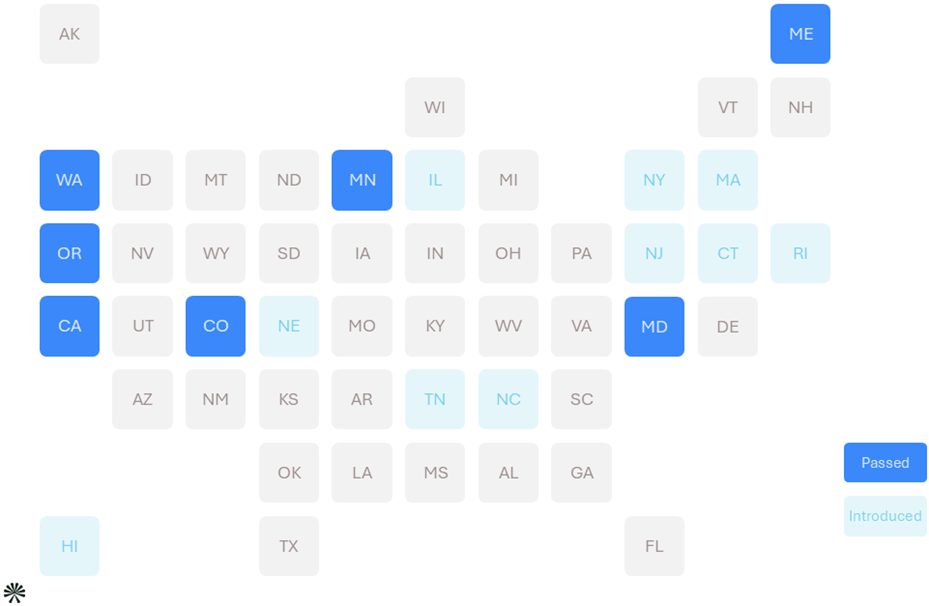
California is on track to have EPR implemented by 2027. Recent developments include:
- CalRecycle recently completed its covered materials list defining packaging that is considered recyclable in California.
- The draft regulations have outlined specific requirements for the use of the “chasing arrows” symbol which has been labeled as misleading by SB 343.
- Circular Action Alliance (CAA) was named as the first Producer Responsibility Organisation (PRO) for California.
This year, companies will need to submit reporting to the CAA to create the baseline that fees will be based on. The reporting period will be open from September 15, 2025 to November 15, 2025, and companies must report their volumes using 2023 sales data.
California has also built targets into their regulations for increasing the recyclability of plastic packaging. On behalf of producers, the PRO must ensure that by January 1, 2032:
- 100% of packaging in California is recyclable or compostable;
- 25% of plastic packaging is source reduced;
- 65% of all single-use plastic packaging is recycled.
Colorado
Colorado, notorious for its below-average recycling rate, is making progress on implementing its Producer Responsibility Programme for Recycling. The Colorado Department of Public Health and Environment has named CAA as the state’s designated PRO and the first report was due on July 31, 2025. CAA is responsible for completing the state’s needs assessment and is the administrator of the funding mechanism.
Colorado’s programme is set to go into effect on January 1, 2026. Next up in Colorado will be receiving finalised rates for invoicing and information on eco-modulation.
Maine
Maine was the first state to pass an EPR bill for packaging in 2021. The programme has been in a rulemaking and implementation phase since its passage, with the Maine Department of Environmental Protection (DEP) working to establish the operational details.
In a significant step forward, the Maine Board of Environmental Protection officially adopted the programme rules in December 2024. A key upcoming milestone is the selection of a Stewardship Organisation (SO) to administer the programme, with the DEP planning to issue a request for proposals in the fall of 2025 and contract with the SO in the spring of 2026.
The most recent timeline indicates that companies will need to start reporting data on the total tons of packaging they introduced into Maine during the 2025 calendar year in 2026.
Oregon
Oregon’s Plastic Pollution and Recycling Modernisation Act, passed in 2021, is a comprehensive EPR law that shifts the financial and operational burden of managing packaging, paper, and food serviceware from local governments to the producers of these materials.
The law officially began its implementation phase on July 1, 2025, with many of the initial improvements happening behind the scenes, such as upgrading recycling facilities and expanding recycling access to more communities. Producers were required to register with a state-approved PRO, with the CAA being the only one currently approved.
The initial deadline for producers to register and report 2024 supply data was March 31, 2025, though a grace period was offered through April 30, 2025. Following the data reporting, producers are now being invoiced and began making payments to the PRO starting on July 1, 2025. These payments will fund the modernised recycling system and reimburse local governments.
Oregon has also issued guidance on eco-modulation and will be rewarding companies that reduce environmental impacts through packaging redesign and disclosure informed by Life Cycle Assessments (LCAs), powerful tools that evaluate the environmental impacts of a product or package across its entire life.
There are three ecomodulation bonuses available to producers:
- Bonus A: Up to $20,000 in base fees as an invoice credit per Product SKU (or for a batch of product SKUs that use the same LCA report) for submitting a third-party reviewed LCA of packaging, for a maximum of 10 SKUs, for a possible invoice credit of up to $200,000
- Bonus B: Up to $50,000 per SKU for demonstrating impact reductions from packaging improvements made since December 2024.
- Bonus C: Incentives for switching from single-use to reusable or refillable packaging systems.
While all three bonuses offer substantial savings, Bonus A is the most immediate and accessible opportunity. Bonus A allows producers to submit up to 10 LCAs, either for individual SKUs or batches of similar SKUs, and receive up to $200,000 in EPR fee reductions for the following year. The bonus is calculated as 10% of the base EPR fees for the materials in each SKU, capped at $20,000 per SKU. While the initial submission deadline has passed, companies should prepare LCAs now to be eligible for Bonus A savings in 2027, positioning themselves ahead of the curve and maximizing future cost reductions.
Importantly, if a company selects 10 SKUs with similar packaging, they may only need to conduct one LCA to cover all of them. LCAs for packaging, especially when formats and materials are consistent, are typically more straightforward and less complex than product LCAs. As a result, the cost of conducting the assessment is only a fraction of the potential $200,000 in EPR fee reductions. When applied, the savings from Bonus A can fully fund the assessment, making it a net positive investment. It also positions companies to qualify for Bonus B and Bonus C in future reporting cycles. This is especially advantageous for companies with high packaging volumes, where EPR fees are substantial.
Anthesis offers a turnkey solution to help you with your process to meet Oregon DEQ’s Life Cycle Evaluation guidance and ISO 14044 standards by following the required methodology and documentation practices. We also offer to coordinate the independent third-party review, streamlining the process and reducing the administrative burden for your team.
Our North America-based team brings together:
- Top-tier LCA practitioners with expertise in plastic packaging
- Packaging engineers skilled in resin analysis and leakage quantification
- Waste experts who understand end-of-life pathways and waste metrics
- Green chemistry specialists for toxicity and health impact assessments
This multidisciplinary approach equips us to address the specific and technically demanding elements of Bonus A, such as plastic and methane leakage calculations, hazardous substance disclosure, and human health impact statements, with precision and rigor.
It’s important to note that while some of the data collected for EPR fee calculations, such as packaging weight and recycled content, can be reused for the LCA, the assessment requires much more detailed and comprehensive information. LCAs dive deeper into the full environmental profile of packaging. This includes data on packaging formats, manufacturing processes, transportation distances, energy use, end-of-life scenarios, and more.
Minnesota
Minnesota’s Packaging Waste and Cost Reduction Act, passed in 2024, establishes a comprehensive EPR programme that requires producers of packaging and paper products to be financially responsible for the recycling system. This shifts the burden from taxpayers to the companies that create the waste.
The law officially began its implementation phase with a significant deadline on July 1, 2025, by which all non-exempt producers were required to register with a state-approved PRO, with CAA currently holding that role. While producers have started to register and data collection is underway, the main funding and operational responsibilities are being phased in.
The first stewardship plan from the PRO is due in October 2028, with full programme implementation, including producers covering at least 90% of recycling and composting costs, by January 2032. The CAA is working to align Minnesota’s guidance with California’s, and the programmes are expected to require similar reporting.
Maryland
Maryland’s EPR law for packaging and paper products, Senate Bill 901, was signed into law in May 2025, making it the sixth state to enact such legislation. This law requires producers to fund and manage a portion of the state’s recycling system through a PRO. While Maryland has already selected CAA as its PRO, the programme is in an early implementation phase.
Producers will need to register with the Maryland Department of the Environment by July 1, 2026. The most significant financial obligations and reporting milestones are still a few years away, with the first producer responsibility plan due on or before July 1, 2028. This plan will establish the eco-modulated fees that producers will pay and will set the initial target for reimbursing municipalities, with a goal of covering at least 90% of eligible costs by 2030.
Washington
Washington’s Recycling Reform Act, signed into law in May 2025, establishes an EPR programme for residential packaging and paper products. This legislation makes producers accountable for the end-of-life management of their products by requiring them to join and fund a PRO.
The implementation of the law is a multi-year process with various deadlines. Producers are required to appoint a PRO by January 1, 2026, and must register with the PRO by July 1, 2026. After that, a PRO must submit a draft programme plan to the Department of Ecology by October 1, 2028. Full programme implementation, including producers reimbursing at least 90% of the recycling system costs, is scheduled to begin in 2032, providing a multi-year runway for a phased transition.