Development in the Sustainable Finance Market

In a global context marked by growing geopolitical uncertainty and instability, the parameters on which economic and financial decision-making has traditionally been based are being redefined. Conflicts such as the war in Ukraine or the persistent tensions in the Middle East, with Iran as a key player, together with other associated factors such as energy volatility and the fragmentation of value chains, are highlighting the vulnerability of the current economic model.
This scenario of uncertainty directly affects markets and the availability of resources, forcing companies, investors and financial institutions to reconsider how they assess risk and long-term value.
Over the last decade, the sustainable finance market has expanded significantly, evolving from a nascent segment into a structural component of the capital markets. Based on Environmental Finance Data shows that the cumulative volume of sustainable debt issuance (including green, social, sustainable and sustainability-linked bonds) has risen steadily, with growth accelerating particularly sharply from 2018 onwards.
However, as shown in the table and chart, during the period 2024–2025 a slight overall contraction of the market has been observed, both in terms of the number of transactions and aggregate volume, with differing trends across instruments:
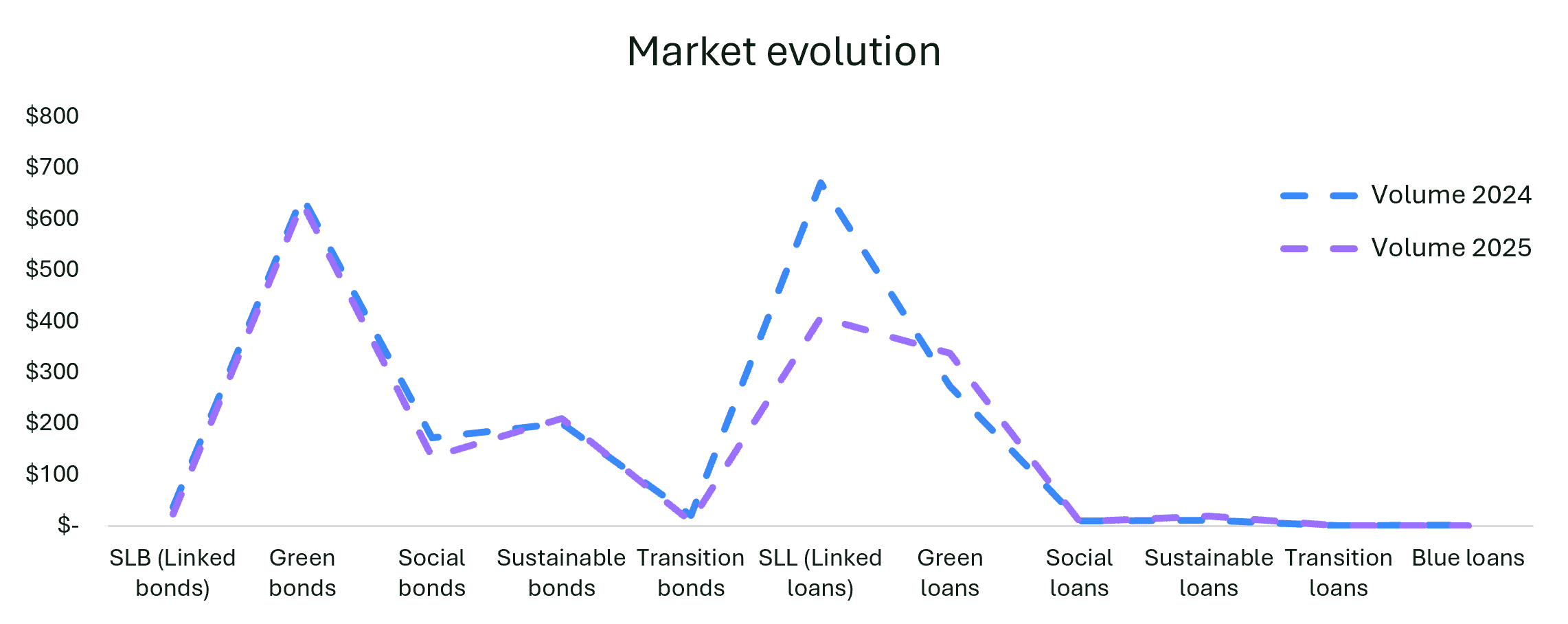
Source: Environmental Finance Data
In terms of composition, green bonds make up the bulk of the market, both in volume and number of issuances, followed by social and sustainability bonds. Sustainability-linked instruments, for the time being, hold a relatively smaller share, highlighting a market preference for structures based on the specific use of proceeds over more aggregated mechanisms. This configuration suggests a growing demand for clarity, traceability, and an explicit link between financing and outcomes.
The expansion of the market has also been accompanied by greater diversification of issuers and geographies. Alongside non-financial corporates and financial institutions, there has been a rise in the prominence of public sector issuers, development banks, and sovereign entities, reinforcing the systemic nature of the market. At the same time, this maturity has led to a clearer differentiation between instruments, particularly between those based on the specific use of proceeds and those linked to general-purpose financing.
This context has been accompanied by increased scrutiny from investors, who are starting to place greater emphasis on the quality of each issuance’s financing framework, as well as on transparency and credibility. One clear example is the greater prominence of green bonds compared to other formats, such as KPI-linked instruments, beyond the mere expansion in volumes.
| The sustainable finance market has grown steadily over the past decade, with strong acceleration since 2018. |
| In 2024–2025, a slight contraction is observed, with fewer transactions and lower aggregate volume. |
| In the bond market, there has been a decline in the number of transactions alongside an increase in total volume, indicating greater concentration and a shift toward larger-sized deals. |
| Green bonds remain at the core of the market in both volume and number, followed by social and sustainability bonds. |
| The market’s greater maturity is reflected in increased diversity of issuers and geographies, as well as heightened investor scrutiny, prioritizing quality, transparency, and credibility over simple volume growth. |
This market evolution has taken place alongside the consolidation of a regulatory framework that has helped embed sustainability at the core of the financial system, particularly in Europe. Through increasing requirements on corporate transparency under the CSRD, disclosure obligations in financial markets under SFDR 2.0, and the classification of economic activities under the Taxonomy, regulation has shifted sustainability from a largely voluntary approach to a more structural, and progressively mandatory, one.
Without going into regulatory detail, this framework has acted as an organizing force for the market, aligning expectations among issuers, investors, and supervisors, and strengthening the role of sustainable finance in capital allocation.
Sustainable finance has entered a more mature phase; current trends are no longer defined solely by market growth or the emergence of new instruments, but by a stronger focus on credibility, data quality and the real impact of capital allocation.
Pese a los avances recientes, el modelo actual de finanzas sostenibles presenta una serie de desafíos estructurales que limitan su efectividad y capacidad de escala:
After reviewing the context, key challenges, and trends in sustainable finance, it is important to highlight that the real challenge will not be the addition of new frameworks, metrics, or tailored products, but ensuring that all this works in practice within an environment marked by uncertainty. Beyond compliance, sustainability in finance must begin to be perceived differently to better understand the importance of adaptation.
Along this path, many companies face more practical than conceptual questions: where to start and how to implement all of this without losing focus on the core business? To what extent is it economically worthwhile to link sustainability to business strategy? This is where external support becomes relevant—not as a source of fixed solutions, but as a means to help prioritize actions, translate regulatory expectations into operational decisions, and connect sustainability with each organization’s financial and strategic reality. Especially for those with fewer resources or limited internal capabilities, such support can make the difference between seeing sustainability as a burden or as a useful tool to navigate change.
If progress is made in this direction, sustainable finance will cease to be an additional exercise and instead become a silent ally: a way to better interpret the environment and build more robust business models prepared for an increasingly unpredictable future.
At Anthesis, we have more than 1,500 sustainability experts and a specialized team dedicated to developing more sustainable and resilient supply chains. To achieve this, we address our clients’ challenges holistically: from defining objectives to implementing key actions, we provide the guidance needed to integrate sustainability into procurement processes.
Through our Sustainable Finance offering, we support financial and non-financial companies in:
Contact us to learn more about how to advance sustainability in your supply chain. We are ready to provide the clarity and guidance needed to support your business in addressing current challenges.
We’d love to hear from you
We are the world’s leading purpose driven, digitally enabled, science-based activator. And always welcome inquiries and partnerships to drive positive change together.


