What is the Modern Slavery Act Australia and how to comply?


Global estimates of modern slavery are at nearly 50 million, meaning approximately one in every 150 people in the world is in some form of forced labour or forced marriage. The International Labour Organisation estimates that in Australia, there are 15,000 people in slave-like conditions. To address this, in 2018, Australia introduced the Modern Slavery Act 2018 (Cth) to combat modern slavery and human trafficking.
In 2026, the Act is undergoing significant reform to move beyond transparency toward mandatory action and enforcement. Here we unpack what the Modern Slavery Act Australia is, who needs to report, statement requirements, quality reporting guidance, the Modern Slavery Act Review and how to comply with the Modern Slavery Act Australia.
The Modern Slavery Act 2018 is a law in Australia that aims to combat modern slavery and human trafficking. The Act requires large businesses and other entities operating in Australia with a turnover of more than $100 million AUD, to report annually on the actions they have taken to address modern slavery risks in their operations and supply chains. The Act is intended to increase transparency and accountability in relation to modern slavery risks, and to encourage businesses to take action to address these risks and protect workers in their operations and supply chains.
While the Act originally focused on “transparency as a catalyst” for change, current 2026 legislative updates are introducing civil penalties and strengthening the role of the Anti-Slavery Commissioner to ensure reporting leads to meaningful remediation.
The Act lists eight exploitations that are classified as modern slavery, including human trafficking, slavery, servitude, forced marriage, forced labour, debt bondage, deceptive recruitment and the worst forms of child labour, which involve slavery practices or hazardous work involving children.
The Act applies to ‘reporting entities’ that have an annual consolidated revenue of at least AUD$100 million and that conduct any part of their business in Australia. These entities are required to prepare a slavery statement each financial year that complies with the reporting criteria presented in the Act. espite recommendations from the 2023 Statutory Review to lower this threshold to $50 million, the Australian Government has formally retained the $100 million threshold for 2026 to focus on improving the quality of disclosures among existing large-scale reporters.
Companies that do not meet the $100 million revenue threshold may choose to submit a voluntary modern slavery statement. A voluntary statement is often prepared by companies or organisations that want to demonstrate their commitment to addressing modern slavery and human trafficking risks in their operations and supply chains, even if they do not meet the revenue threshold or other criteria required by the legislation. This is increasingly common for organisations aiming to demonstrate a commitment to ethical operations and supply chain transparency. A voluntary modern slavery statement must comply with the same criteria in the Act.
Voluntary statements can be a useful tool for companies and organisations to communicate their commitment to responsible business practices and to encourage transparency and accountability in relation to modern slavery risks. They can also help to build trust with stakeholders and consumers and differentiate the company or organisation from its competitors.
Voluntary statements are becoming more common as organisations mandated to report extend these requirements throughout their supply chain, seeking to better understand how suppliers are addressing modern slavery risks and to evaluate potential suppliers accordingly.
In 2026, voluntary reporting has become a strategic necessity for many SMEs. As mandated large-scale entities face potential penalties and stricter oversight from the Anti-Slavery Commissioner, they are passing these requirements down their supply chains. Suppliers who provide high-quality voluntary disclosures often gain a competitive advantage by reducing the due diligence burden on their larger corporate clients.
Under the Modern Slavery Act Australia, reporting entities that meet the revenue threshold and operate in Australia are required to prepare a Modern Slavery Statement (MSS) within six months of the end of their financial year. To comply with the Act, entities must include the following information:
Important 2026 Update: While the Act originally established seven mandatory criteria, the Australian Government has agreed in principle to expand these requirements. In addition to the existing criteria, the Anti-Slavery Commissioner and the Attorney-General’s Department are finalising new mandatory disclosures.
To ensure compliance, an MSS must now address the following:
Approval and Submission: The statement must be approved by the entity’s principal governing body (e.g., the Board), signed by a responsible member (e.g., a Director), and submitted to the Online Register for Modern Slavery Statements.
Businesses must submit their modern slavery statement within six months of the end of their financial year. For example, if a company’s financial year ends on 31 December 2025, their statement must be submitted by 30 June 2026. Similarly, if a company’s financial year ends on 30 June 2026, the deadline is 31 December 2026.
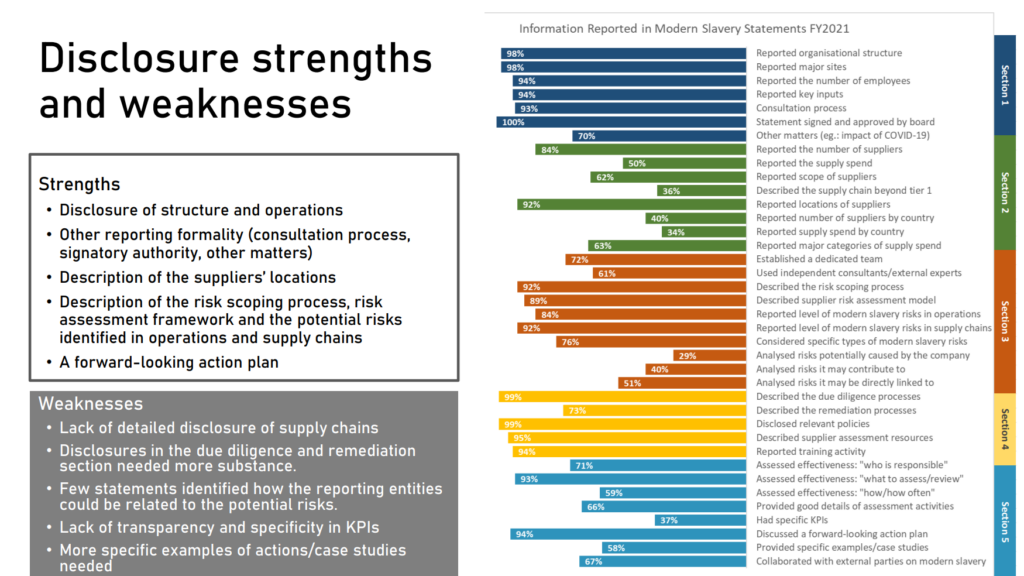
Monash University’s Modern Slavery Disclosure Quality Report provides critical insights into reporting trends. from the ASX 100, which is a good resource on what to do – and what not to do – for companies preparing or revising their statements. This report presents the results of Monash’s Modern Slavery Research program, breaking down disclosure strengths and weaknesses, quality of responses and areas for improvement and provides well-researched insights on how to improve the quality of the modern slavery statement.
The FY24/25 findings highlight that while over half of the ASX100 now receive an ‘A’ grade for disclosure, many still fail to report on measurable outcomes. Strong statements in 2026 must go beyond “policies” and demonstrate real-world impact for vulnerable workers.
Strong Modern Slavery statements address the following:
Legislative Reforms (2025–2026): Following the 2023 Statutory Review, the Australian Government accepted 25 of 30 recommendations. Critically, the Government decided to retain the $100M revenue threshold, focusing instead on strengthening the quality of existing reports.
The review was informed by an extensive public consultation process involving over 280 government and non-government organisations, including those from business, civil society and academia. 136 written submissions were provided to the review from a wide range of domestic and international stakeholders.
In December 2024 the Australian Government released its response to the review report of the
Modern Slavery Act 2018 (Cth). The Review made 30 recommendations, of which it fully agreed to 13, agreed in principle to 12, and noted five.
Key updates from the Government Review of the Modern Slavery Act include:
With potential penalties for non-compliance on the horizon, organisations must ensure they are fully meeting the current reporting requirements under the Modern Slavery Act. And while the government didn’t commit to implementing mandatory human rights due diligence, they did commit to running consultations on the matter, so organisations would do well to bring themselves up to global best practice standards regarding managing human rights risks in their supply chains.
These developments indicate a strengthened commitment to enhancing corporate responsibility and transparency in combating modern slavery.
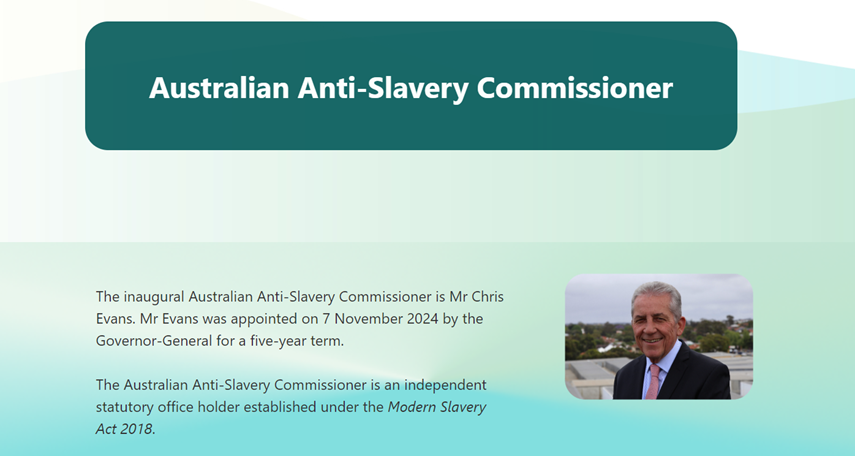
Australia’s inaugural Anti-Slavery Commissioner, Mr. Chris Evans, commenced his five-year term in December 2024. As an independent statutory officer, the Commissioner is now leading the national effort to improve compliance.
In 2026, the Commissioner’s office is focused on:
With the Commissioner’s office now operational and possessing investigative powers, the regulatory landscape has moved from voluntary transparency to active oversight.
The shift toward civil penalties and mandatory due diligence means that “standard” reporting is no longer enough. Our team of human rights experts at Anthesis supports organisations in moving beyond compliance to achieve meaningful impact. Whether you need help addressing the Commissioner’s new guidance or conducting deep-dive supply chain due diligence, reach out to our team today.
We’ve been technical experts and trusted advisors to some of Australia’s most well-known companies for over a decade, contact us to learn more or call +61 3 7035 1740.