SFDR Reporting Requirements
A Guide to the Sustainable Finance Disclosure Regulation
In this guide, we introduce the SFDR, including what it is, who it applies to, what the requirements are, an explanation of Article 6, 8 and 9, and how Anthesis can help with your SFDR reporting and strategy.
The EU Sustainable Finance Disclosure Regulation (SFDR) aims to improve transparency, reduce greenwashing, and promote sustainable investments. It requires financial service providers, asset managers, and owners of financial products to assess and disclose environmental, social, and governance (ESG) considerations publicly. The requirements are detailed in the Regulatory Technical Standards (RTS).
The SFDR came into effect in March 2021, with further requirements for financial products beginning on 1st January 2023. Firms must make their SFDR disclosures by 30th June on an annual basis.
The regulation applies to all financial market participants (“FMPs”) and financial advisors (“FAs”) in the EU – including any with EU shareholders or marketing themselves in the EU – and sets out clear disclosure requirements.
The products that it encompasses include (not exhaustive): investment and mutual funds, UCITS, insurance-based investment products, private and occupational pensions and insurance and investment advice.
In November 2025, the European Commission published a formal proposal to revise the SFDR – commonly referred to as SFDR 2.0. The proposal represents the most significant change to the regulation since it came into force, shifting from a disclosure-led regime to a product categorisation system and reducing entity-level reporting obligations.
Key proposed changes include:
The timeline remains uncertain, with SFDR 2.0 expected to come into force no earlier than late 2027 or 2028. Firms should begin mapping existing fund strategies to the new categories now.
The SFDR disclosure obligations are divided into three categories:
Obligated firms must disclose the potentially negative consequences an investment decision may have on sustainability factors and how they are mitigating the impacts, known as Principle Adverse Impacts (“PAIs”). These sustainability factors include environmental aspects, such as energy performance and water usage, and social aspects like employee matters and respect for human rights.
Firms below the 500-employee threshold can chose to opt in or out of PAI reporting at firm level under Article 4 and at product level under Article 7. Article 4 embeds a “comply or explain” principle, broadly phrased as follows:
Several firms have instead charted a third course: explaining that whilst they do not consider PAIs within the meaning of the SFDR, they nonetheless report meaningful ESG data.
Firms must disclose where an ESG event could negatively impact material investments and align their remuneration policies with sustainability risk management.
Where a product is categorised as an Article 8 or Article 9 product (see below), additional disclosures need to be made.
| Entity-Level 1 Disclosure Requirements: obligations for the entities themselves concerning their policies on decision-making on sustainability risks. | Product-level 2 Disclosure Requirements: obligations concerning the financial products and their sustainability risks. |
|---|---|
| Details on how sustainability risks are integrated into the entity’s investment decision-making process or financial advice [Article 3 SFDR]. A firm must publish a statement of intent on its website to demonstrate which Article it intends to align to. | Firms must provide additional disclosures depending on the objective of each product. |
| A statement outlining policies regarding the consideration of Principal Adverse Impacts (PAIs) on sustainability factors [Article 4 SFDR]. | For firms considering PAIs, an explanation of how financial products address these impacts should be furnished. This applies to all products offered by the firm, regardless of whether they aim to achieve sustainability objectives [Article 7 SFDR]. |
| Information on how remuneration policies align with the integration of sustainability risks [Article 5 SFDR]. | Products promoting “environmental” or “social” characteristics must provide information on how these objectives are met, including disclosure on the extent of alignment with the EU Taxonomy Regulation of underlying economic activities [Article 8 SFDR]. |
| Pre-contractual disclosures concerning the integration of sustainability risks, including assessments of how financial product performance may be influenced by these risks [Article 6 SFDR]. | Products with a sustainable investment objective must explain how these objectives are pursued, along with additional disclosure on alignment with the EU Taxonomy Regulation [Article 9 SFDR]. |
On their websites, FMPs shall also publish their policies for due diligence on the adverse impacts of their investment decisions on sustainability factors.
Entity-level disclosures are published on a firm’s website and apply to the organisation as a whole – not to individual funds or products. They are intended to give clients a clear picture of how the firm integrates sustainability considerations into its investment decision-making and advisory processes.
Financial market participants and financial advisers are required to publish the following on their websites:
Entity-level disclosures are mandatory for financial market participants with more than 500 employees. Smaller firms below this threshold may still be required to publish product-level disclosures, and must provide a comply-or-explain statement on PAIs regardless of size.
Entity-level disclosures must be kept up to date continuously – they are not a once-a-year submission. The annual PAI statement, where applicable, is published by 30 June each year based on data from the prior calendar year.
The proposed SFDR 2.0 revision would remove entity-level PAI obligations under Article 4 and entity-level remuneration disclosures under Article 5 entirely. Until the revised regulation comes into force, current requirements remain in effect.
Product-level disclosures apply to each individual financial product that an FMP markets to clients in the EU, providing investors with insight into the sustainability characteristics or objectives of specific funds. Unlike entity-level disclosures, which are website-only, product-level obligations span three channels:
Pre-contractual disclosures: Published before a product is marketed or sold, these must describe how sustainability risks are integrated into investment decisions, and explain any likely material impact those risks could have on returns. For Article 8 and 9 products, pre-contractual documents must also describe how environmental or social characteristics are met, including disclosure on the extent of alignment with the EU Taxonomy Regulation.
Website disclosures: A publicly accessible summary of key sustainability information for each product must be published on the firm’s website, kept in a dedicated section and updated regularly. This is effectively a subset of the pre-contractual information, maintained on an ongoing basis.
Periodic disclosures: Published annually alongside the fund’s annual report, periodic disclosures summarise the product’s sustainability performance over the reference period. For Article 8 products, this must include the extent to which the environmental or social characteristics promoted were met. For Article 9 products, it must cover how the sustainable investment objective was pursued. Where a product uses a designated reference benchmark, a comparison of the product’s performance against that index must also be included.
PAI disclosures at the product level: Entity-level PAI disclosures must address all 14 core PAI indicators. Product-level disclosures follow the same indicators but have slightly more flexibility – firms are strongly encouraged to include carbon-related metrics such as Scope 1–3 emissions on a product-by-product basis, as this is increasingly expected by institutional investors.
Principal Adverse Impacts are defined under SFDR as the negative effects – material or likely to be material – on sustainability factors that are caused, aggravated by, or directly linked to investment decisions and advice performed by a financial market participant. PAI reporting is widely considered the most technically demanding aspect of SFDR compliance, requiring granular data collection across portfolio companies throughout the year.
In total, there are 14 mandatory PAI indicators applicable to investments in corporate issuers – 9 environmental and 5 covering social and governance factors – which all firms in scope must report against. These are defined in Table 1 of Annex I of the SFDR Delegated Regulation (EU) 2022/1288. In addition, firms must report on at least two further indicators of their choice from the optional list: one environmental and one social. There are 46 discretionary indicators in total across Tables 2 and 3 of Annex I.
The 14 indicators above apply specifically to investments in corporate issuers. There are two additional mandatory indicators for investments in sovereigns and supranationals, and two for real estate assets. Firms with mixed portfolios must report against all applicable mandatory indicators across each asset class.
SFDR disclosures must be published by 30 June each year, with a reference period covering the previous calendar year — 1 January to 31 December. In practice, this means data collection needs to begin well before the deadline, as PAI calculations require quarterly data gathering across the full reference year.
| Disclosure type | Deadline | Reference period |
|---|---|---|
| Entity-level PAI statement (Article 4) | 30 June annually | 1 Jan – 31 Dec (prior year) |
| Product-level PAI disclosures (Article 7) | 30 June annually | 1 Jan – 31 Dec (prior year) |
| Article 8 & 9 periodic reports | 30 June annually | 1 Jan – 31 Dec (prior year) |
| Pre-contractual disclosures | Before product is marketed | Ongoing |
| Website disclosures (Articles 3, 4, 5) | Maintained continuously | Ongoing |
To enhance transparency, reduce greenwashing, and substantiate asset managers’ sustainability claims, the SFDR distinguishes between three types of product classification:
Funds that claim to align with ESG or sustainability factors must be classified as either Article 8 or 9. Article 8 funds promote environmental and social characteristics, and follow good governance practices, but do not have sustainability as the core objective. Article 9 funds, however, have stricter disclosure requirements and must have sustainability as their core objective.
The regulation aims to reduce greenwashing and the overstating of green credentials. The European Commission found in an assessment of 344 “seemingly dubious claims” on the environment that nearly half (43%) were false or deceptive and 37% included purposely misleading or vague statements like “eco-friendly” or “sustainable”.
Not only will the SFDR help organisations focus on ESG risks during the investment process, but in addressing an existing gap in mandatory rules for ESG disclosure, the SFDR aims to spark a behavioural change for FMPs.
It follows a wave of new policies preserving investor value by stimulating greater investment in ESG disclosure. With recent years proving that organisations with strong sustainability credentials can significantly outperform conventional funds during shocks, the focus on legitimising green credentials can be seen as a vital push to protect revenues and asset values from future disruption. This also follows a broader cultural shift, with climate policy being a key point in many national elections and ESG risks at the forefront of investors’ minds following the aftershocks of the COVID-19 pandemic.
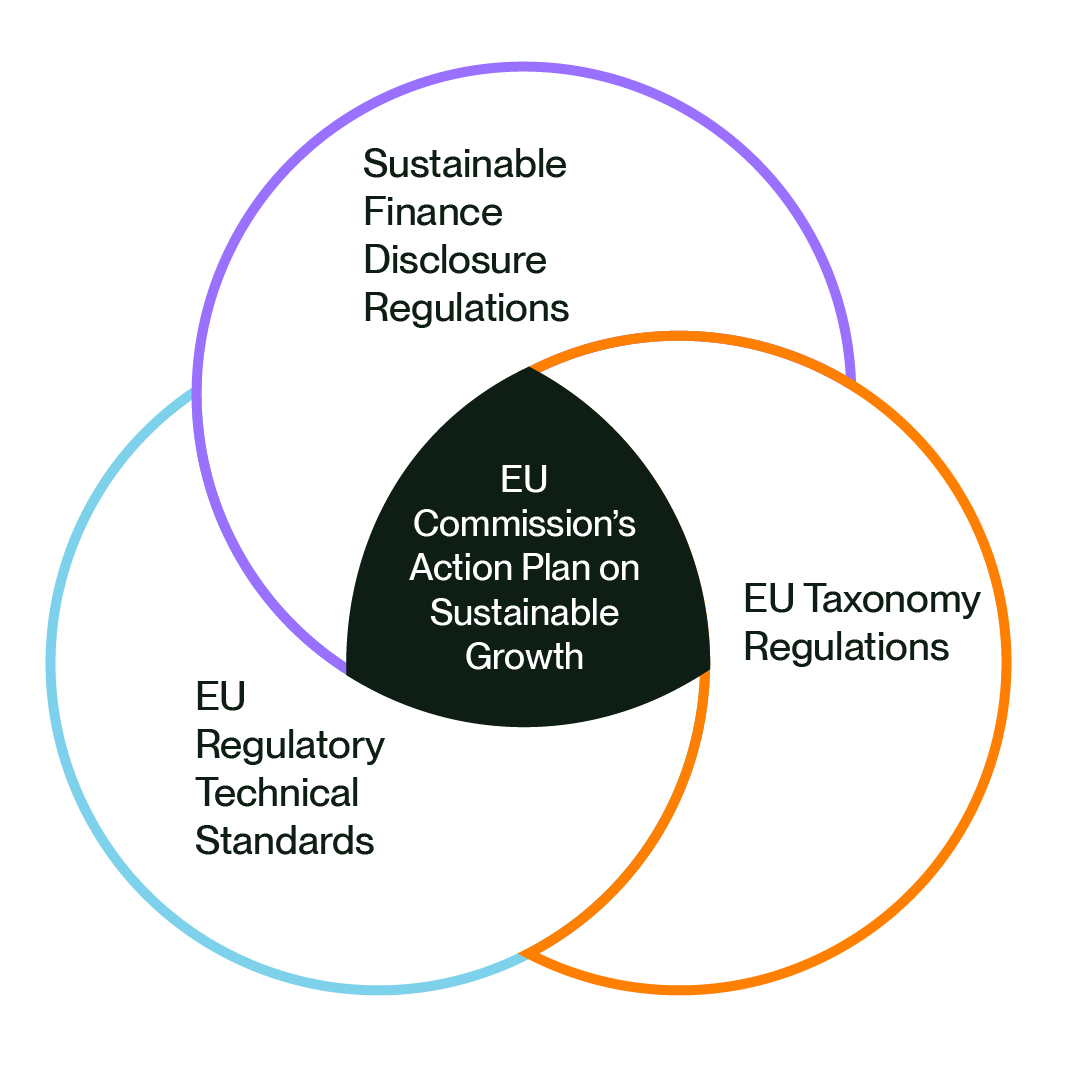
The SFDR is a gateway to further ESG-related legislative activity as part of the European Commission’s Sustainable Finance Action Plan. It complements the EU Taxonomy Regulation, which looks to establish whether an economic activity is environmentally sustainable. Complying with obligations for financial products under the SFDR activates disclosure requirements from the taxonomy. Similarly, entities follow the taxonomy regulation to comply with the SFDR.
For FMPs and FAs that operate in the EU to market investments as Article 8 or 9, they will need to review the whole lifecycle of their products, from initial product development, marketing, and contracting, through to monitoring, reporting, and updating their policies and processes.
The following areas need to be addressed:
Anthesis’ Sustainable Finance Team can provide support to your firm through the development of an SFDR framework, a roadmap to disclosure, and relevant reporting templates to support your PAI data collection process. We can also undertake EU Taxonomy-aligned workstreams to support the evidencing of Do No Significant Harm (“DNSH”) criteria, PAI calculations, and broader disclosure support. Our experience with financial institutions and fund managers enables us to incorporate the requirements of the SFDR into due diligence tools for private equity firms and develop SFDR screening frameworks for firms to assess and evidence the entity and product-level impact against PAIs.
To ensure your SFDR strategy aligns with your broader ESG or Investment strategy, we can help to align corporate sustainability and private equity strategy against the ever-changing landscape of standards and regulations. This can involve an assessment of materiality, benchmarking, and peer reviews, as well as ESG metrics and KPI setting and annual report writing.
We also conduct climate risk assessments for corporates and private equity clients to help them align with the requirements of EU Taxonomy climate criteria in addition to the Task Force on Climate-Related Financial Disclosures (TCFD).
Entity-level disclosures apply to the firm as a whole and must be published on the firm’s website. They cover how the firm integrates sustainability risks into its investment decision-making process (Article 3), whether and how it considers principal adverse impacts across all investment activities (Article 4), and how its remuneration policies align with sustainability risk management (Article 5). These disclosures describe the firm’s overall approach and governance — not the characteristics of any individual fund.
Product-level disclosures apply to each individual financial product the firm markets in the EU. They are made across three channels: pre-contractual documents (before a product is sold), the firm’s website (maintained on an ongoing basis), and periodic reports (published annually). The depth of product-level disclosure depends on how the product is classified — Article 6 products require a sustainability risk statement only, while Article 8 and 9 products require significantly more detailed disclosure on how environmental or social characteristics or sustainable investment objectives are pursued and achieved.
The practical distinction is that entity-level disclosures tell investors how a firm thinks about sustainability; product-level disclosures tell them what a specific fund actually does.
The core annual deadline for SFDR disclosures is 30 June each year, based on data from the prior calendar year (1 January to 31 December). This applies to entity-level PAI statements, product-level PAI disclosures, and Article 8 and 9 periodic reports.
Pre-contractual disclosures must be in place before a product is marketed — there is no fixed annual date, but they must be kept up to date on an ongoing basis. Website disclosures under Articles 3, 4, and 5 are also subject to continuous maintenance rather than an annual filing.
Firms relying on third-party or portfolio company data for PAI calculations should note that all 14 mandatory indicators must be calculated at the end of each quarter and averaged for the annual submission. This means data collection needs to be in place from 1 January of the reference year — not assembled retrospectively in the weeks before the June deadline.
Article 8 and Article 9 are product classifications under SFDR that indicate the level of sustainability ambition a fund promotes. They are often informally called “light green” (Article 8) and “dark green” (Article 9).
Article 8 funds promote environmental or social characteristics — for example, by screening out certain sectors or integrating ESG factors into their investment process — but do not have sustainable investment as their core objective. They must follow good governance practices and disclose how those characteristics are pursued, but there is no minimum threshold for the proportion of the portfolio that must qualify as a sustainable investment.
Article 9 funds go further: they must have sustainable investment as their core objective, with investments qualifying as sustainable under Article 2(17) of the SFDR — meaning they contribute to an environmental or social objective, do no significant harm to any other objective, and the investee companies follow good governance practices. Materra Article 9 funds carry the most detailed disclosure requirements, including alignment with the EU Taxonomy Regulation and, where applicable, reference to a Paris-aligned or EU Climate benchmark.
A key practical distinction is that Article 8 classification can be triggered relatively easily — the European Commission has confirmed that even indirect claims or impressions that a product considers ESG characteristics in its investment policy can be sufficient to bring a product into Article 8 scope. Materra Firms should review all fund documentation and marketing materials carefully to avoid unintentional classification.
Under the proposed SFDR 2.0 framework, the Article 8 and 9 designations would be replaced with three new product categories — Transition, ESG Basics, and Sustainable — with binding eligibility criteria for each.
Principal Adverse Impacts are the negative effects that investment decisions may have on sustainability factors — including environmental, social, employee, human rights, anti-corruption, and anti-bribery matters. PAI reporting is designed to make visible the harm that a portfolio may cause or contribute to, rather than just the ESG risks that the portfolio faces.
Under SFDR, PAI obligations exist at both entity level and product level. At entity level, firms above the 500-employee threshold must publish an annual PAI statement disclosing how their investment decisions adversely affect sustainability factors across all 14 mandatory indicators. Firms below this threshold must either publish the statement or explain why they have chosen not to. At product level, Article 8 and 9 products must explain how the product takes PAIs into account in its investment strategy.
The 14 mandatory indicators span nine environmental metrics — including GHG emissions, carbon footprint, biodiversity impact, emissions to water, and hazardous waste — and five social and governance metrics, including the gender pay gap, board gender diversity, UN Global Compact violations, and exposure to controversial weapons. Firms must also report on at least two additional optional indicators: one environmental and one social.
The answer depends on how a non-EU firm operates in relation to EU markets — and there are meaningful distinctions depending on the firm’s structure and activities.
SFDR extends its reach to non-EU entities that market or appear to market financial products to EU clients. This means that US, UK, Asian, and other non-EU asset managers that manage or distribute funds to EU investors are subject to product-level SFDR obligations for each product they market into the EU — regardless of where the firm itself is based or domiciled.
The European Commission has confirmed that SFDR applies to non-EU AIFMs marketing into the EU via National Private Placement Regimes (NPPR), and that product-level disclosure requirements apply in these circumstances. The position on entity-level obligations for non-EU firms is less settled: the stronger legal view is that firm-level disclosures under Articles 3 and 5 do not apply to non-EU AIFMs using the NPPR, though individual member states may interpret this differently.
Non-EU portfolio managers who have been delegated investment management functions by an EU AIFM are not directly subject to SFDR, but may be contractually required by the EU AIFM to provide the sustainability data and disclosures that the EU manager needs to meet its own obligations. In practice this means that non-EU firms acting as sub-advisers or delegates to EU-managed funds should expect increasingly detailed ESG data requests from their EU counterparts.
UK-based firms are not subject to EU SFDR following Brexit, but are instead subject to the FCA’s Sustainability Disclosure Requirements (SDR), which operates on a different — and largely incompatible — basis. Firms operating across both markets need to manage compliance with both regimes separately.
SFDR 2.0 refers to the European Commission’s formal legislative proposal, published on 20 November 2025, to revise the Sustainable Finance Disclosure Regulation. It is the most significant proposed change to the framework since the regulation came into force in 2021.
The key changes proposed include replacing the Article 6/8/9 classification with a new three-category product regime (Transition, ESG Basics, and Sustainable), removing entity-level PAI reporting obligations under Article 4, capping pre-contractual disclosures at two pages and periodic disclosures at one page, and removing financial advisers from scope entirely.
The proposal will be subject to trilogue negotiations between the European Parliament and the Council of the EU before it is formally adopted. Once adopted, SFDR 2.0 is expected to apply 18 months after entry into force — making late 2027 or 2028 the current best estimate for implementation. All existing SFDR obligations remain fully in effect until that date.
We are the world’s leading purpose driven, digitally enabled, science-based activator. And always welcome inquiries and partnerships to drive positive change together.