ESPR: The Ban on Destruction of Unsold Goods
New measures will prohibit the destruction of certain unsold goods beginning July 2026
27 March 2026

New measures will prohibit the destruction of certain unsold goods beginning July 2026
27 March 2026

In February this year, the European Commission adopted new measures under the Ecodesign for Sustainable Products Regulation (ESPR) that will prohibit the destruction of certain unsold products, beginning with apparel, clothing accessories and footwear, from 19 July 2026.
The measures aim to tackle a long-criticised practice in the fashion sector, where usable products are destroyed rather than reused, donated, or recycled.
Estimates suggest that 4–9% of unsold textiles are destroyed before ever being worn, generating around 5.6 million tonnes of CO₂e emissions each year.
Alongside the ban, companies will also be required to disclose how unsold products are handled, increasing transparency and turning what was once largely hidden from view into both a regulatory compliance issue and a reputational risk.
This article explores what the new rules mean for apparel companies and how they can take practical steps now to prepare for compliance and maximise opportunity.
The ESPR forms part of the EU’s wider shift towards a more circular and resource-efficient economy. It has the potential to change the way products are designed, sold, used and reused in Europe, with varied coverage based on individual product category rules.
The ESPR is designed to:
In particular, the rules on unsold products and disclosure obligations will require businesses to rethink how excess inventory is handled and how product sustainability is documented.
Learn more about the EU Ecodesign regulation, how it will affect you and what you need to do to comply.
To support the EU’s objective of reducing waste from unsold products, the legislation introduces two key requirements for companies set out in the Delegated and Implementing Acts:
The destruction ban currently applies only to apparel, clothing accessories, and footwear, as listed in Annex VII of the ESPR.
Other consumer product groups are not currently subject to the destruction ban but remain subject to disclosure obligations for discarded unsold consumer products. The European Commission may extend the ban to additional product categories in the future by amending Annex VII through delegated acts.
Some broad product categories, such as food, animal feed, and medicinal products, fall outside the scope of the ESPR altogether. However, as the regulation applies broadly to physical goods, including components and intermediate products, related items such as packaging may still fall within scope depending on the applicable requirements.
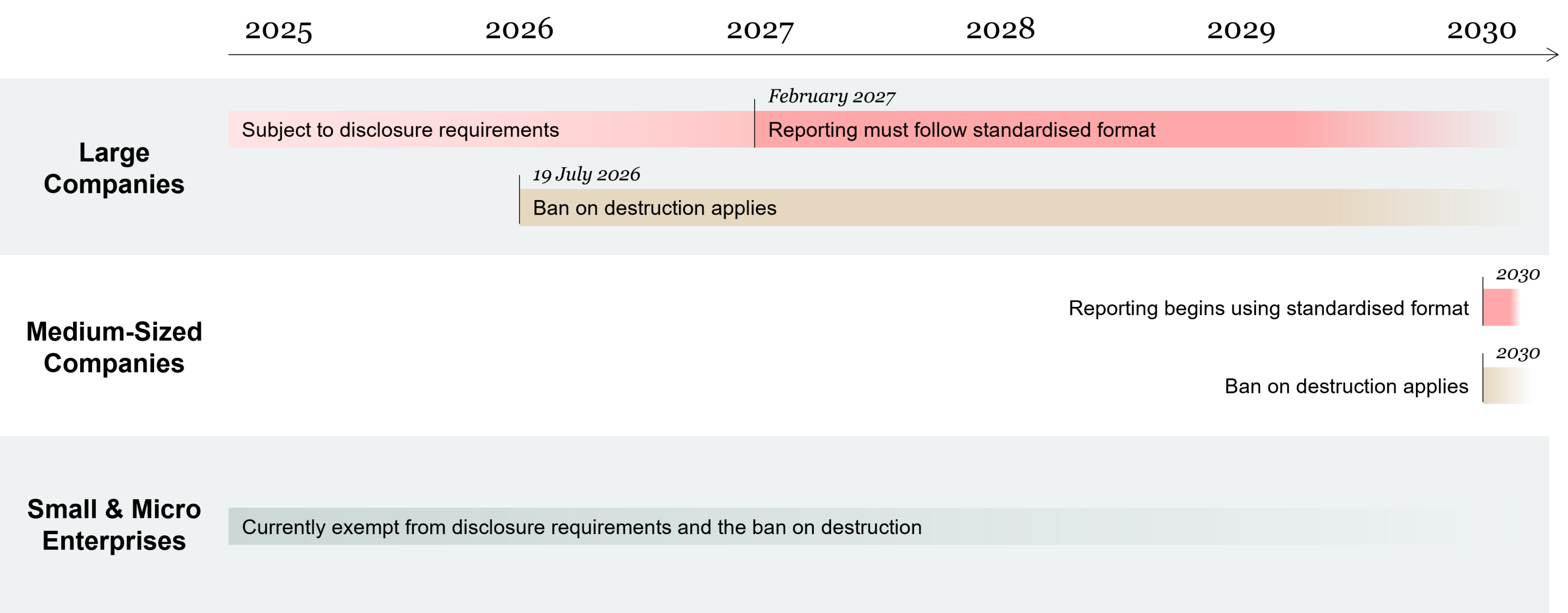
The ESPR applies to economic operators placing products on the EU market, including manufacturers, importers, distributors, and online platforms. The obligations under the destruction ban vary depending on company size.
Under the ESPR, “destruction” means physically damaging products as well as the deliberate discarding of unsold goods as waste once they have been placed on the market. This would include, for example, sending unsold products for disposal, energy recovery, and notably, recycling.
Sending products for recycling does not automatically avoid the prohibition where the destruction ban applies. It is also important to appreciate that before recycling or other waste treatment is considered, companies are expected to prioritise preparation for reuse, such as refurbishment, repair, or remanufacturing. In real terms, this means brands will need to consider the condition of unsold goods, ensuring these are distributed to the correct channel to enable the best reuse outcome of each product. This will be very different for different garments and could create opportunities for brands to take ownership of their ‘waste,’ turning it into a positive revenue stream.
This reflects the waste hierarchy, which prioritises waste prevention and reuse over recycling and disposal.

Recycling may still take place where products are not suitable for further use and fall within one of the available derogations. In those cases, any destruction must follow the waste hierarchy set out in Article 4 of the Waste Framework Directive (Directive 2008/98/EC).
Where products are donated, they are not counted as destroyed products for the purposes of the disclosure requirements. Donation partners will be a key element of success to avoid destruction and might involve brands re-thinking how and where they donate their products.
While the ESPR generally prohibits the destruction of unsold apparel, clothing accessories, and footwear, the Commission’s February 2026 delegated act (download) identifies a number of limited exceptions. These derogations allow destruction in clearly defined circumstances, provided companies can evidence their decision with appropriate documentation (which will then need to be collected) and notify waste treatment operators of the applicable justification.
| Derogation | Evidence required |
|---|---|
| a) Dangerous products | Safety assessment, test report, or other documentation showing the product poses a health or safety risk or contains non-compliant chemicals. |
| b) Non-compliance with law | A self-assessment statement identifying the non-compliance and the relevant Union or national law. |
| c) IP infringement | A court or ADR decision, notification from a rights holder or authority, or internal investigation substantiating the infringement. |
| d) Expired licence or contractual restriction | The relevant licence, contract or agreement, together with justification that destruction is appropriate and proportionate. |
| e) Reuse or remanufacturing not technically feasible | Inspection report or other supporting evidence showing that labels, logos or other recognisable characteristics cannot be removed or made permanently inaccessible. |
| f) Damaged, deteriorated or contaminated products | Evidence from quality assessment procedures or inspection records showing the damage and why repair or refurbishment is not technically feasible or cost-effective. |
| g) Design or manufacturing defects | Evidence from quality assessment procedures or inspection records showing the defect and why repair is not technically feasible. |
| h) Donation not accepted | Evidence that the product was offered for donation to at least three suitable social economy entities in the EU, or on an accessible website page for at least eight weeks, without being accepted. |
| i) Donated product with no recipient | Declaration confirming the product was received as a donation and no recipient could be found. |
| j) Prepared for reuse, but no recipient found | Documentation showing the product was received from a waste treatment operator and no recipient could be found. |
The ESPR requires Member States to establish penalties for non-compliance of the regulation. Companies that fail to comply with the destruction ban, disclosure requirements, or documentation obligations may face enforcement action from national authorities, including fines, corrective measures, and requests for supporting documentation.
Some Member States have already introduced national measures addressing the destruction of unsold goods. For example, France’s Anti-Waste for a Circular Economy (AGEC) law prohibits the destruction of unsold non-food products and requires companies to prioritise reuse, donation, or recycling, with fines of up to €15,000 for non-compliance per violation.
Destroying products can also be a risk to a company’s bottom line from a reputational sense as well. Negative press resulting from destruction of viable sellable product has been seen for both luxury and high street brands, with customers reacting poorly to both the ethical challenge of destroying perfectly good items, as well as the perception of brands’ wasteful behaviour.
For large companies, the ban on destruction is coming into force in July 2026, with disclosure requirements already in place and due for updated formatting in 2027. Medium-sized companies will follow closely behind with disclosure requirements beginning in 2030. Is your company ready?
Here are some practical steps you can take to reduce compliance risks and ensure your business is ready when the new rules take effect:
Once you have this information, you can determine where current practices are non-compliant with the upcoming regulation, design a strategy and roadmap for its implementation, and identify any partnerships or internal standard operating procedure and policy changes that may be needed.
Our team brings deep expertise across the apparel and textile sectors, helping brands make sense of the evolving regulatory environment. As the ESPR ban on the destruction of unsold goods approaches, we support companies in designing and executing strategies that both elevate the environmental performance of their entire product portfolio and ensure alignment with broader business goals.
Our experts can support you in:
Preparing for the ESPR requirements alongside other existing and forthcoming regulations affecting the apparel industry requires careful, proactive planning. We can work with you and sector associations to provide essential guidance and practical pathways to compliance. By taking early action on the ESPR ban, apparel brands can not only reduce operational and reputational risks but also minimize associated costs and position themselves as sustainability leaders within the sector.
Learn more about the EU Ecodesign regulation, how it will affect you and what you need to do to comply.
We are the world’s leading purpose driven, digitally enabled, science-based activator. And always welcome inquiries and partnerships to drive positive change together.