Nature Due Diligence: Identifying Risks and Uncovering Opportunities
Addressing the nature imperative while mitigating risk
10 December 2025

Addressing the nature imperative while mitigating risk
10 December 2025
Financial institutions are increasingly under pressure to better understand how investments both impact and depend on nature, and how to manage and mitigate associated nature risks. An enhanced due diligence process helps organisations identify risks and potential value creation opportunities early in the investment process.
In this article, we provide an overview of nature due diligence, outline helpful resources to leverage for this process, and provide recommendations for successful completion.
Nature due diligence is a process that aims to support asset managers in identifying how the operations of their portfolio companies impact and depend on nature. These insights can be used to identify material nature-related risks and opportunities pre-transaction, potentially informing valuation or posing a red flag for investment. Nature due diligence can also enable deal teams to build buy-in and focus on enhancing nature management practices during ownership.
Due diligence that accounts for nature helps translate ecological risks into business risk . This is particularly helpful if an institution is active in one of the eight priority sectors that the Nature Action 100 – an investor-led engagement initiative supported by the sustainability nonprofit Ceres – has identified as being systemically important for reversing nature and biodiversity loss by 2030.
Companies operating in these sectors, such as biotech or food production companies, both depend on nature for resources and negatively impact nature by degrading ecosystems through sourcing raw materials. These sectors’ reliance and impacts on nature create business risks, such as supply chain disruptions and increased regulatory scrutiny.
Through leveraging nature due diligence, asset managers will:
Including nature in decision-making has only more recently begun to gain traction in corporate and financial circles, thanks to emerging nature-reporting frameworks, such as the Task Force on Nature-Related Financial Disclosures (TNFD), Science Based Targets Network (SBTN), Corporate Sustainability Reporting Directive (CSRD), and more. Recently, the International Sustainability Standards Board (ISSB) announced its intent to introduce new disclosure requirements considering nature-related risks and opportunities, to meet investor information needs.
While these frameworks are largely geared toward post-acquisition reporting, they offer valuable insights and structures that can be adapted for pre-acquisition due diligence. Additional resources to support an organisation through the nature due diligence process include:
By leveraging these nature reporting frameworks, structures, and recommendations early, asset managers can enhance their due diligence processes, strengthening their ability to identify nature-related risks and uncover opportunities for value creation during the initial phases of investment analysis.
TNFD is a global market-led initiative aiming to support a shift in global financial flows away from nature-negative outcomes and toward nature-positive outcomes. It aligns closely with several other sustainability standards, such as the ISSB and GRI, and can be used to respond to CSRD’s European Sustainability Reporting Standards (ESRS). Given TNFD’s connection to several standards, asset managers can leverage its guidance to consider how nature can be integrated into their due diligence processes.
TNFD provides asset managers with a structured approach to understand and manage their reliance on nature, and to integrate nature into their decision-making processes through four pillars: Governance, Strategy, Risk and Impact Management, and Metrics and Targets.
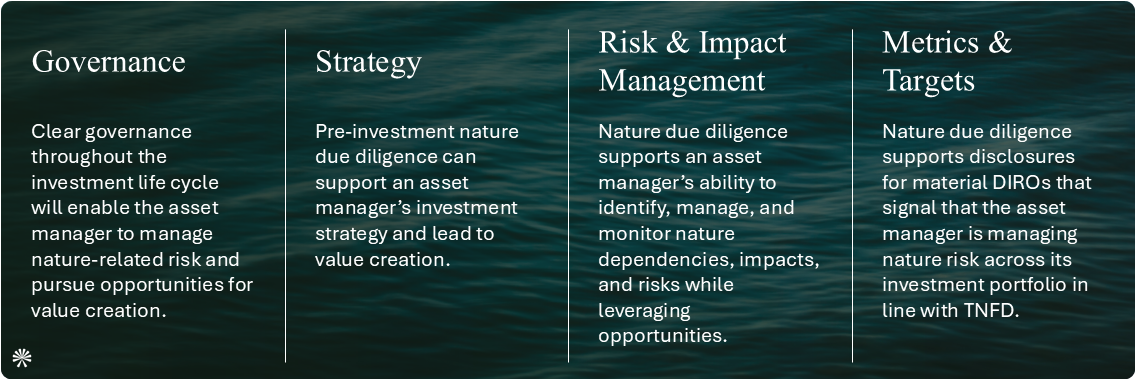
Specifically, the strategy pillar calls for the disclosure of nature-related dependencies, impacts, risks, and opportunities (DIROs), as well as their effects across the business, value chain, and financial planning, and their overall resilience across scenarios. Through aligning with TNFD’s recommendations to identify and disclose on DIROs, asset managers may begin integrating nature-related considerations into their due diligence processes.
In addition to its core recommendations, TNFD’s guidance for financial institutions encourages disclosure of how nature-related risks and opportunities are considered in product and service offerings, investment processes, risk management practices, and due diligence standards. Through being asked to disclose how their due diligence integrates nature, asset managers are prompted to include nature considerations across financial decision-making and portfolio oversight, including assessing portfolio companies for nature-related DIROs. For portfolio companies with significant nature-related DIROs, TNFD recommends that asset managers describe additional engagement or due diligence processes to manage these material DIROs.
While nature has always been the resource on which our economy depends on, only recently has the global biodiversity crisis brought nature to the forefront of financial and corporate agendas. Nature’s connection to other sustainability topics such as climate change, water, and supply chain disruption has continued to become increasingly clear. Integrating nature risks into existing due diligence processes allows for a robust and comprehensive analysis for informed decision making.
To refine current processes and to integrate nature considerations into an enhanced due diligence process, Anthesis recommends that organisations consider the following:
Developing an enhanced nature due diligence process allows organisations to identify both risks at the initial phase of the investment process as well as potential opportunities for value creation. By integrating frameworks like TNFD, organisations can systematically assess their dependencies and impacts on natural ecosystems and ensure alignment with global biodiversity goals. To remain stewards of nature, organisations should embed nature-focused due diligence into their investment strategies to establish resilience and long-term value creation.
At Anthesis, our nature experts and global sustainable finance team support clients in reviewing their current approach to conducting pre-acquisition nature due diligence on potential investments. We identify opportunities for enhanced due diligence across the portfolio by conducting nature risk and opportunity assessments, peer benchmarking, and identifying disclosure risks, all whilst aligning with key frameworks.
We are ready to support on any of the above recommendations, whether taking your first steps into nature due diligence, or already working on a strong narrative for exit.
We work with private equity and asset management firms around the world, helping them build robust due diligence processes that incorporate nature.
We are the world’s leading purpose driven, digitally enabled, science-based activator. And always welcome inquiries and partnerships to drive positive change together.